
By Tracy Record
West Seattle Blog editor
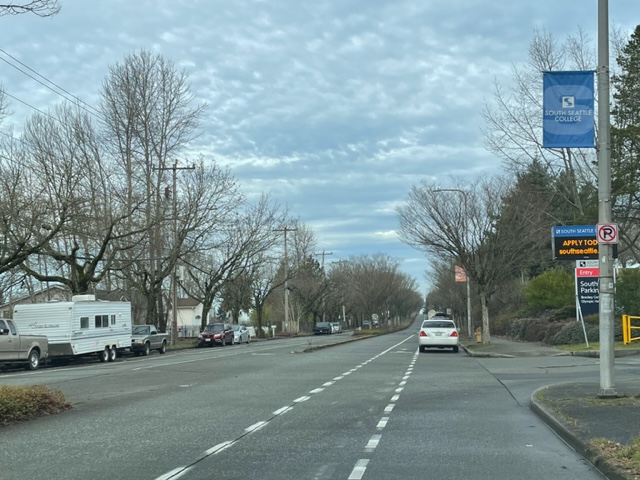
More than 50 people filled a room at South Seattle College‘s Cascade Hall last night for a “community conversation” about parking along 16th Avenue SW in front of the campus.
The west side of the median-divided street is lined with single-family homes, and the street parking is relatively devoid of signage, so in addition to the vehicles of students and staff – who have to buy permits to park in campus lots – street parking is also used by RV/trailer/truck residents. The number fluctuates but we counted 10 on a visit earlier this week.
While that wasn’t mentioned in the meeting announcement, that was clearly what everyone was there to discuss – though not all agreed on what was at the heart of it. A panel of city reps included Tom Van Bronkhorst from the Unified Care Team; Mike Estey from SDOT; and Laura Fox from SPD Parking Enforcement (a listed panelist from the city’s “unsheltered services” program did not show up). SSC communications director Ty Swenson facilitated. Also there but not seated with the panel in front of the room were SSC president Dr. Monica Brown and District 1 City Councilmember Rob Saka‘s new policy adviser, Brendan Kolding.
The college wants to be “more than a neighbor in name … also a neighbor in deed,” said Dr. Brown in brief welcoming remarks. Swenson said SSC was trying to “approach this conversation” with a better understanding of “the needs of our unhoused population.” He said the conversation’s goals included the “opportunity to share your experiences” and to learn about the city’s approach to “supporting the unhoused population” and “parking enforcement” – tincluding the options that might be available for the latter.
Fox was the first city panelist to speak and said she empathized with the situation. Estey said, “We keep getting introduced as experts (but) it’s hard to be an expert on this issue.”
Swenson then provided “background from the college perspective,” saying Van Bronkhorst had contacted SSC last fall about possibly installing parking-restriction signage. “One of the things (he shared) was that these days the city most commonly puts up 2- and 4-hour signs” but that might not work for students, so SSC was looking for a wider range of possibilities. Swenson said they also were concerned that restrictions would just move RVs “further down the road.”
Van Bronkhorst spoke next, explaining the Unified Care Team – representatives from 10 city departments, “one part of the city’s overall response to homelessness … working on restoring access to public spaces” among other things. The UCT is “not a first-responding group” and “our mission is not to solve homelessness,” he clarified.
Fox said Parking Enforcement works with UCT, coming out during remediations and giving three-day warnings (those familiar orange notices). But they usually don’t move, and don’t get towed because people are living in them, she explained.
An attendee then spoke out about observing a recent situation where no-parking signs went up, people in RVs left, “and they came back.” Another attendee then voiced concern for trauma to the people who have been swept. Another attendee stood up and said she wants everyone to have someplace to live, and she’s paid taxes for that. But “we’ve dealt with so many things in the city in the past five years.” So has she, saying for example, she had to replace her fence, had to call police for someone peeping into her home. “Are there conseaquences when people are offered shelter (and don’t take it)?” She mentioned streets in other neighborhoods with barriers such as rocks. She said the city’s had five years to collect data but all she sees is the UCT “replacing propane canisters … The frustration is, I want everybody to be housed, you have the data, where is the plan? Do something …” She also said she was frustrated that Councilmember Saka himself was not in attendance. “He should be here,” she said, her voice continuing to intensify. Many in the room applauded when she was finished.
The next person to speak said, “There should be campers outside Rob Saka’s house … there should be campers outside all our houses” until things were equalized. Others in the room demanded to know whether the speaker owns property. The speaker replied, repeatedly, “I live here.”
Next person: Why aren’t tickets being given out, considering that the RVs block the bike lanes? Parking Enforcement supervisor Fox said there’s a rule for that but a ticket isn’t going to remove the RV. “There has to be someone calling in, we’re not just driving around looking,” She added that parking enforcement officers have safety concerns. She said that precinct officers often assist PEOs, and promised to “try to get out here more often.”
Another attendee said RV dwellers have been “aggressive” and also voiced concern that notification of the meeting hadn’t been distributed widely enough. They were followed by a person who said she had had more than half a dozen people in her family experiencing homelessness. “These people are being left out there to die … There is nothing compassionate (about that) …” She said at least one person had died in the area. “I would like the developers, the city, to fix th housing crisis” but believes that’s not going to happen any time soon. She thinks “a light, tight mobile camp” would be better, without room for big RVs – otherwise people are “sitting out there as bait for predators.”
The open-mic type of sequential commenting continued. Next was a resident identifying himself as a homeowner who said he’d put up a camera for six months to record what’s happening on the street. He said he had recorded some doing things he doesn’t like, but others are doing good things. “We ought to be forming relationships with them.” He says he has footage of people causing trouble for the RV residents – “we need to come up with a solution and not” treat them like outcasts. “They have nowhere to go. … We need to solve this problem at a housing level,” not at a level of making RV dwellers the enemy.
But almost every time someone suggested the need for that solution, someone else declared that wasn’t the point of the meeting, parking was. The next speaker declared she’s :empathetic’ but is fed up with problems such as a couple in one RV who frequently fight, with the disruption spilling out into the neighborhood. She added that she herself is an immigrant and naturalized citizen and “came here with nothing.” Then she suggested that there “are two different kinds of unhoused” … one type who “truly wants the help,” the other type who does not.
Shortly thereafter, Van Bronkhorst explained the outreach process and its limitations. “We don’t have a lot of great housing options .. we offer shelter, services, that are not great for a lot of people … we offer tiny house villages” but usually vacancies are rare because tiny houses are so popular. For RVs, they first try to clean up the area before a removal, “we’ll talk to them about their needs to keep their vehicles moving.” That’s when Van Bronkhorst spoke of the RV-safe-lot/tiny-house village plan we broke the news about last week (up to 72 RVs, 20 tiny houses), though he had few details.
SDOT’s Estey (who is the department’s curb-space manager) then took the mic to steer the focus back to the parking restriction issue. He said they’ve been installing 4-hour limits in places where people with RVs might want to park – “the (signs) tend to be self-enforcing.” (He is ‘curb space manager’ for the city. He also acknowledged that restrictions would “push the RVs to other places.” They tend to install such signage just on the commercial side (which in this case would be the east side, in front of SSC) because on the residential side there are more impacts. “There’s probably not a permit solution,” he said, for those wondering about RPZs, since there are specific conditions that need to be met. They could do a study, he said, to verify whether an RPZ would be justified. And he acknowledged that, yes, overnight parking is illegal, but SPD isn’t staffed overnight to enforce that.
Could they put jersey barriers every 30 feet or so? he was asked. “Our preference is not to have to default to something like that,” or putting eco-blocks in the right of way, Estey said, “but we also understand why they end up there because people feel a sense of desperation.” Van Bronkhorst said the last mayoral administration did not enforce removal of ecoblocks but he doesn’t know what “the new administration” thinks. He mentioned some neighborhoods putting out metal planters. “That’s not legal,” several attendees said, while others quickly pointed out no one was enforcing that. (A little while later, someone else mentioned that the arrival of ecoblocks after a sweep on Highland Park Way seemed to have preceded RVs’ move to 16th. They said they’d reported street obstructions via Find It Fix It but “they’re still there.”)
Another person wondered whether there should be special consideration here since SSC is a school. Estey observed that “it’s unique that you have a college with single-family (homes) across the street.” He said parking enforcement would likely come out more often if there were signs. “We need parking restrictions on both sides of the street,” an attendee said. “And at Sanislo Elementary,” added another, referring to Puget Ridge’s other school.
Van Bronkhorst mentioned another signage tactic, putting up signs asking for voluntary compliance “be a good neighbor, kids live here too.”
Then an attendee who said they’ve lived in the area for 32 years read a statement about her “personal experience.” She said crime problems had arrived with the RVs. “I don’t think sweeping is the answer, but we’re not here to solve the housing crisis.” She said her car had been stolen, and several others spoke up to say theirs had too. She said she is not comfortable walking in the neighborhood any more and declared “this isn’t about punishing pople who live in vehicles, this is about public safety.”
The next speaker countered by declaring that everyone is a neighbor, including renters, and RV dwellers. She said parking restrictions would likely push RV dwellers into places “in front of people’s homes” while currently they tend not to be “in front of people’s entryways.”
“What about the north lot, could they park there during the day?” A college rep explained that tudents pay $50/quarter for permits and the north lot is open to them at any time. “Why not open that up and let the students park there for free?” Soeone asked how many students pay for parking passes; 700 was the guess.

A few murmurs around the room started coalescing around signage with 11 pm to 5 am restrictions like on Harbor Avenue (as shown above in a WSB photo from September 2023). An attendee who said they had worked on signage for a variety of concerns countered, “Signs in this case do not solve the fundamental (problem) we’re trying to deal with … I don’t think signs are going to solve the problem.” They said someone does park in front of their residence and “I do not want them swept.” Signs are being deployed to push people out of the area, they said. They support the north lot parking idea. Others in the room said they felt signage would help the situation. Then again, the point and counterpoint, some saying “we’re not here to solve the housing crisis” and others saying, “You should be.”
Fox from Parking Enforcement said most vehicle dwellers don’t have registration. She thinks RV “safe lots” are the solution. “That way all the services come to them.” Someone wanted to know if RV dwellers will be “compelled” to go to the safe lot once open. That attendee claimed people in a few of the RVs are “running criminal enterprises” and won’t want to. “When they say no … what are you going to do?”
Van Bronkhorst replied, “Well, people have a choice” and also mentioned potential obstacles that kept some people in RVs from being able to access such lots in the past, such as having to prove their ownership of the vehicle and being on a pathway toward housing and eventually giving up their RV. He isn’t sure if that’ll be the policy. But no, he reiterated they’re not going to force people into the lots. (The request came later, though, that West Seattle RV dwellers get priority at the West Seattle lot.)
So, the discussion turned back to, what signage might be tried in the area?
“No overnight parking … both sides of the street.” voices said from around the room.
Then again came a reminder that the problem goes beyond parking, advocating for state legislation supported by the Seattle/King County Coalition on Homelessness.
Another man stood up and said, “We give way too much services to these people, 60 percent don’t even come from this area.”
That led to further points and counterpoints – including whether the topic was parking or homelessness, another attendee suggesting that government “has a spending problem,” another suggesting enforcement is needed rather than more signs, yet another wondering about a “no camping” ordinance, and someone else turning the attention to the Highland Park downhill-lane removal and wondering how many were aware SDOT is planning on that. “I just wanted to say that out loud,” he said. “SDOT ran surveys, most people are against (the project), and they’re going to do it anyway.” Estey said he’d “take that sentiment back” to SDOT HQ.
That in turn segued into questions about how feedback from this meeting will be conveyed to decisionmakers. Any other routes for providing community input? they wondered. Another attendee suggested, “The folks (who park) are there because they (consider that) their best option – we can either make this option worse or make other options better … I think the compassionate choice is to make other options better.” A “no camping” ordinance would be irrelevant, he said, because “they’re not camping … this is their house … you can’t stop camping if that’s your house.”
Then Estey took on the followup question. He said people can contact the city. Van Bronkhorst asked for contact info from 16th SW residents: “I think we’ve heard enough options we could make some suggestions … to remediate the situation as it currently is … it seems neighbors have been asking for a ‘now’ answer … we can come up with some options, send them to (Swenson at SSC), and get some feedback.” He declined to hone in on just one idea immediately, and would not commit to a timeline for a proposal and action, even acknowledging, with uneasy laughter, that the response was basically a “non-answer.”
The addresses provided were two contacts at SSC:
brian.jellum@seattlecolleges.edu (security)
ty.swenson@seattlecolleges.edu (communications)
From the city:
mike.estey@seattle.gov
tom.vanbronkhorst@seattle.gov