
 (WSB photos by Jason Grotelueschen)
By Tracy Record
West Seattle Blog editor
It’s easy for community meetings to get stuck on one particular issue or hotspot, if the facilitator(s) let them.
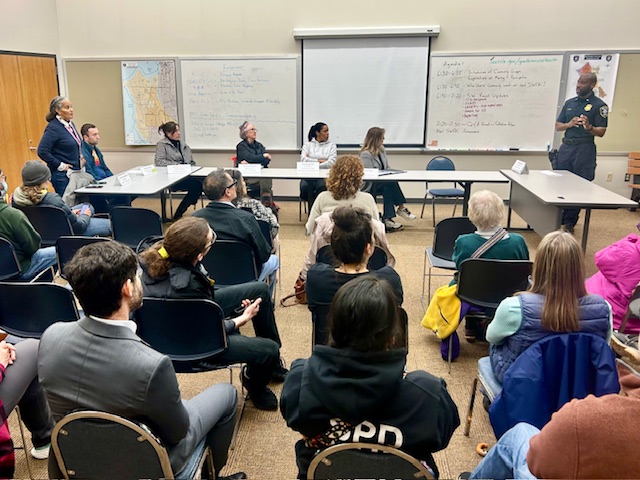
To avoid that last night at the quarterly Southwest Precinct Advisory Council community meeting, SPD Crime Prevention Coordinator Matthew Brown and SWPAC’s community lead Ella McRae stressed focusing on issues with “West Seattle-wide” or even citywide effects, and how the community can collaborate on solutions.
The two-dozen-plus people in attendance at the precinct took that mostly to heart. First, here’s our video of the meeting so you can see/hear it all for yourself:
In addition to the incident updates we reported late last night immediately after the meeting, SPD precinct leaders provided updates on ongoing areas of concern:
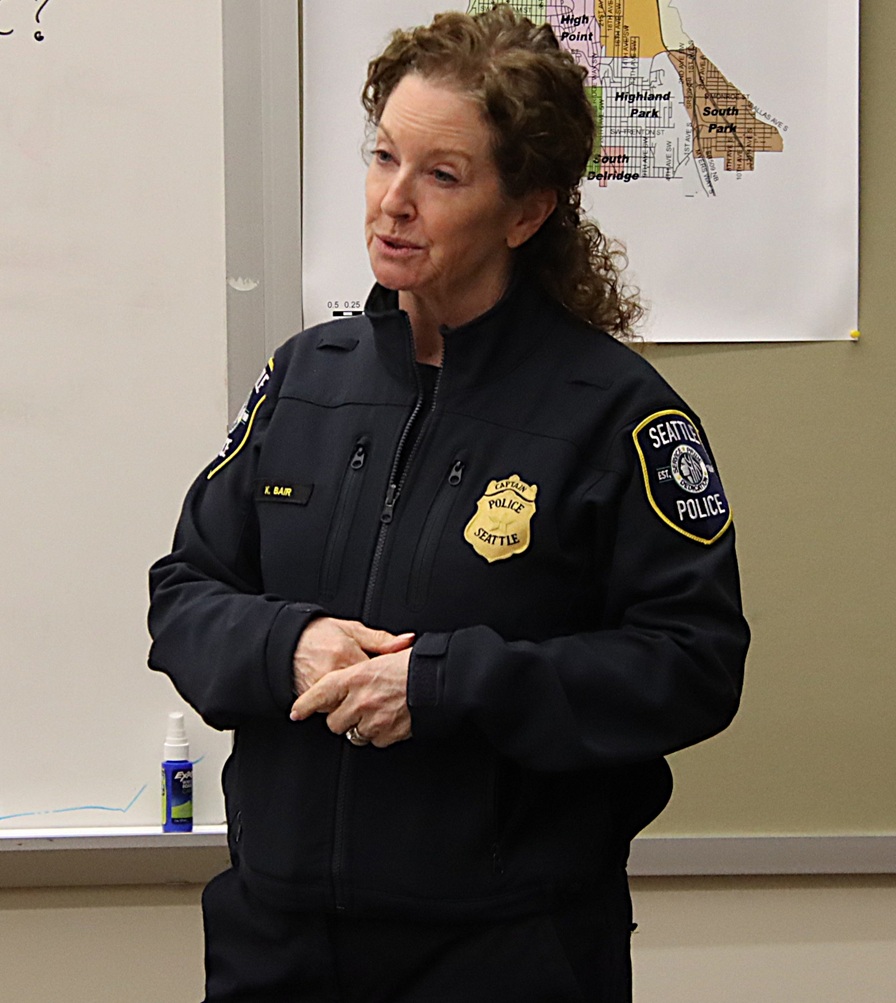
PLANNING FOR SUMMER SAFETY ON ALKI (AND ELSEWHERE): SW Precinct commander Capt. Krista Bair said summer-safety planning is starting early this year, as it didn’t begin until May last year and it was agreed, that was too late. They’re working with “partner agencies” again this year – it “can’t be just (SPD)” tasked with safety. But so far, she said, she’s “impressed and encouraged by this group of people” and notes the results will be “measured and tracked” a lot more than last summer.
Unique this summer will be the FIFA World Cup games; Capt. Bair said some resources will definitely be “reallocated” from the precincts but “most officers” will remain. She’s expecting an influx of tourists to West Seattle and side effects such as possibly increased Water Taxi runs.
Speaking of staffing, an attendee asked her about it. SPD overall is still up 90+ officers after last year’s hiring outpaced departures; she said their recruiting is much more visible outside Seattle than it had been. Precinct staffing, she said, remains at the same level since she took over more than a year and a half ago.

CRIME TRENDS: SW Precinct Lt. Wes Collier took over for this update. He cited the same citywide stat as heard at community meetings since the start of the year, that crime dropped almost 20 percent overall. Though this area had no homicides last year, he said it’s noteworthy that citywide, 86 percent of all homicide cases were cleared last year, compared to about 50 percent for the preceding year. West Seattle violent crime is down 9 percent, property crimes down 20 percent, Collier said.
WESTWOOD VILLAGE: This remains a “property crime” hotspot in West Seattle. But police say they’ve been collaborating more closely with center security and that’s been leading to arrests like the ones mentioned here: “We’re trying to change the environment over there.” If you’ve noticed red signs in windows at WWV businesses, that’s part of a “trespass warning” program, and Lt. Collier said 90 percent of the businesses there have signed up. “We have a great relationship with the security guards over there,” he added. And they’ve been working with prosecutors to “be sure cases get the proper attention” and to provide them with the information needed to file charges.
WESTSIDE NEIGHBORS SHELTER: The shelter in The Triangle was a major topic of last fall’s SWPAC meeting (WSB coverage here). Lt. Collier said the shelter and police are continuing to collaborate to try to “deter some activity” – drug use, etc. – in the area, and that shelter management has made some changes too. SPD has an “emphasis car” there when possible, he added. Later in the meeting, Chris Mackay, who represents the West Seattle Junction Association (of which she is executive director), said the shelter remains a major concern for merchants who believe some of the street disorder continuing in The Junction is a spillover effect. Conrad Cipoletti, vice president of the Morgan Community Association, mentioned the trouble at bus stops; Lt. Collier noted they’re the purview of the King County Sheriff’s Office Transit Police, and encouraged online reporting of non-urgent situations (otherwise, 911 when something is happening now)
SECURITY CAMERAS: During the incident updates, Lt. Collier mentioned the Connect Seattle program through which residents and businesses can register their cameras. Charlotte Starck, the Alki Community Council president who represents ACC on SWPAC, asked for more details. Brown noted that this area has the most registered cameras so far. “We’re not reaching into your house, not looking at your stuff,” Capt. Bair emphasized – the program is voluntary, and when you register, you’re in a database so that if something happens nearby, police can more easily find out who might have had cameras that might have recorded something. Also, signing up does not obligate you to turn over your video. That led to a question about whether city-owned cameras are part of the program, and from there, the issue of whether city anti-crime cameras might be removed. That’s when newly elected City Attorney Erika Evans was announced as in attendance:
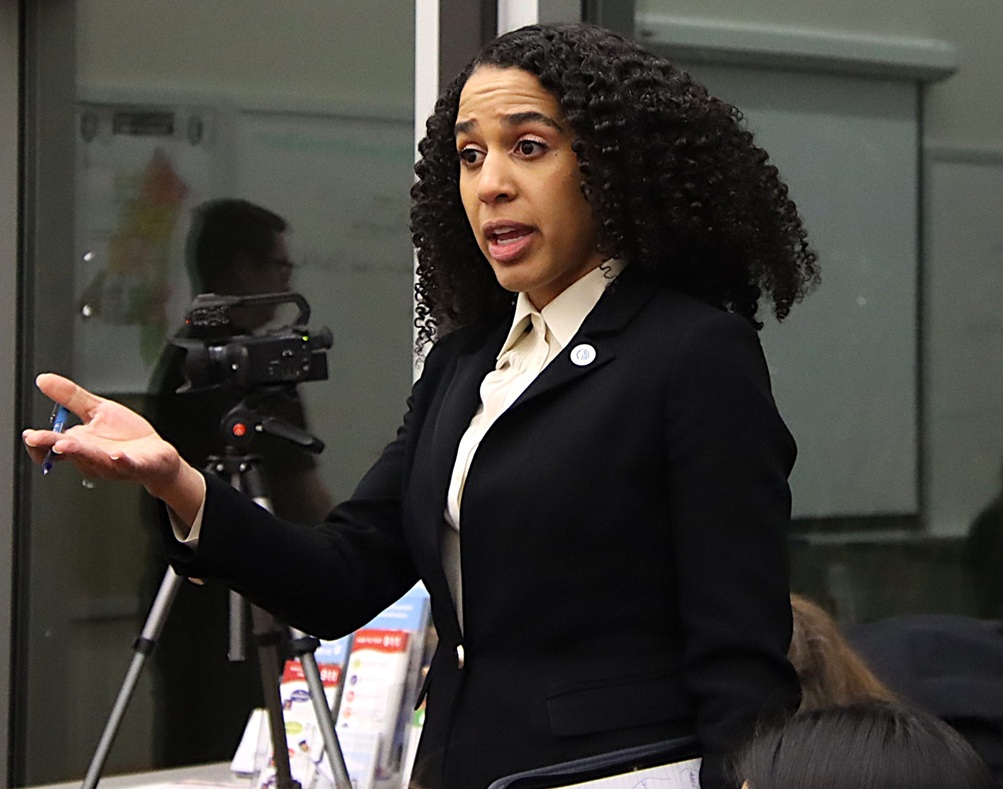
Evans noted that it’s up to the mayor to make that decision (as Mayor Katie Wilson had noted in her State of the City speech earlier in the day).
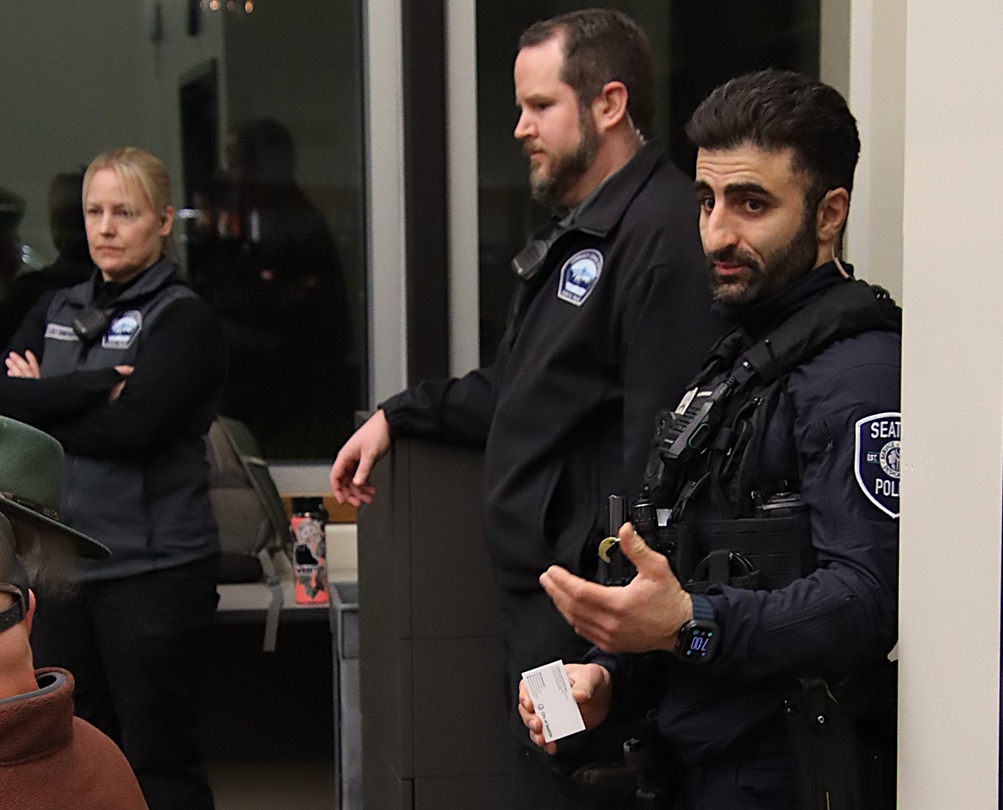
CRISIS RESPONSE: The meeting also heard from a Crisis Response Team officer, explaining where they differ from the CARE Team and Community Service Officers as well as social workers who respond to certain crisis calls too. A CSO explained that mental-health responses are not their specialty – helping access resources for people “who just might be having the worst day of their life” is.
ICE RESPONSE: Brown said that if you think you see ICE activity, don’t try to interrupt “because that’s a crime” but do “be a good witness” – with your camera if you can – and call 911 because SPD “can make sure everyone’s safe” by responding to the scene.
REPORTING CRIME AND SAFETY CONCERNS OVERALL: Here’s the list Brown put on the whiteboard in the precinct’s community room:
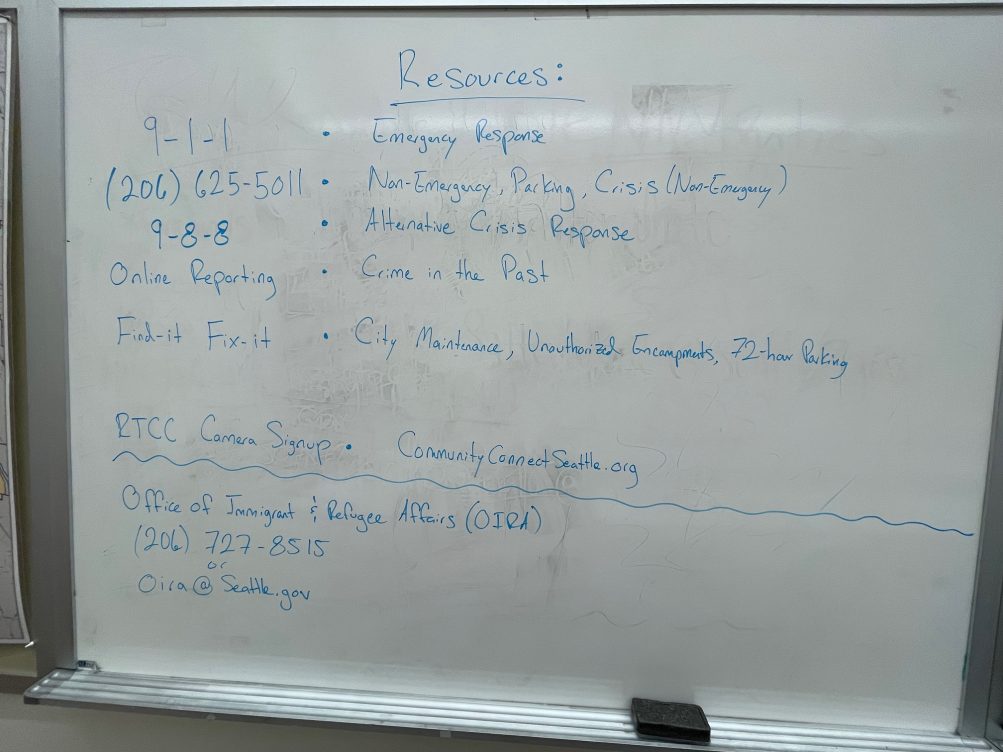
But if you’re not sure, Brown said, call 911 and they’ll help guide you to the right place.
OTHER COMMUNITY CONCERNS: Mackay mentioned business break-ins (The Junction has been heavily affected as well as Alki) An attendee asked whether drug use in public is now legal (there was confusion several weeks back); Evans said no, but the law still favors trying first to get people into treatment and “we’ll prosecute if that’s not progressing.” Kay Kirkpatrick from HPAC said the burned van was only one of at least seven vehicles in seven weeks in the West Duwamish Greenbelt, but at least the gate at the bottom of Highland Park Way hill has been replaced and its lock fortified. Kirkpatrick said that the upcoming Glassyard Commons RV/tiny-house site was also likely to draw more trouble to the nearby greenbelt areas.
NEXT MEETING: The SWPAC will reconvene in May (if you have concerns for SPD in the meantime, there are usually reps at other regular neighborhood-group meetings including Admiral, Alki, Fauntleroy, Highland Park/Riverview/South Delridge, and Morgan). When Brown asked last night’s group what topics/guests they would like to see considered for the May meeting, suggestions included SDOT to talk about traffic, King County Sheriff’s Office to talk about how they and SPD collaborate, and security for the World Cup games, which will be just a few weeks away by then. If you have suggestions – or crime-prevention-related questions – Brown is reachable at matthew.brown@seattle.gov. And Capt. Bair had a final request: If crime happens, “please don’t NOT report.”