
 (WSB file photo)
By Tracy Record
West Seattle Blog editor
Saving salmon – and in turn, saving animals that need them, like Southern Resident Killer Whales – is a painstaking job.
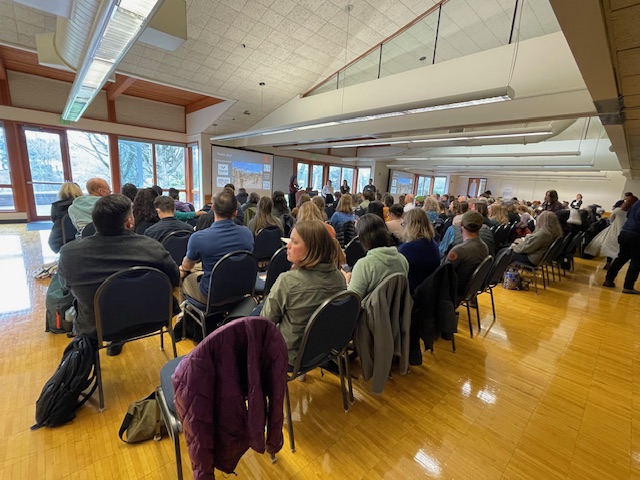
Just ask the dozens of people who gathered steps from the Duwamish River’s southern stretch this past Tuesday to share strategies and successes about restoring the river’s habitat. We accepted an invitation to cover their presentations.
Much of what we hear about cleaning up and restoring the Duwamish River and its watershed focuses on pollution, contamination, and the multi-billion-dollar, decades-long work of cleaning it up. But those gathered for the Duwamish River Habitat Symposium (held at Tukwila Community Center) are the ones who take over after that – turning former industrial sites back into places where fish, plants, insects, and people can flourish.
The presentations touched on common problems – Canada Geese seeing restored habitat as a tasty buffet, for example. They also celebrated successes – at a Harbor Island site owned by Vigor, it was declared triumphantly that, “Juvenile salmon are feeding.” That’s at an area that hasn’t been “heavily used” since World War 2, right by the mouth of the Duwamish. They’re ultimately restoring it for insects, too.
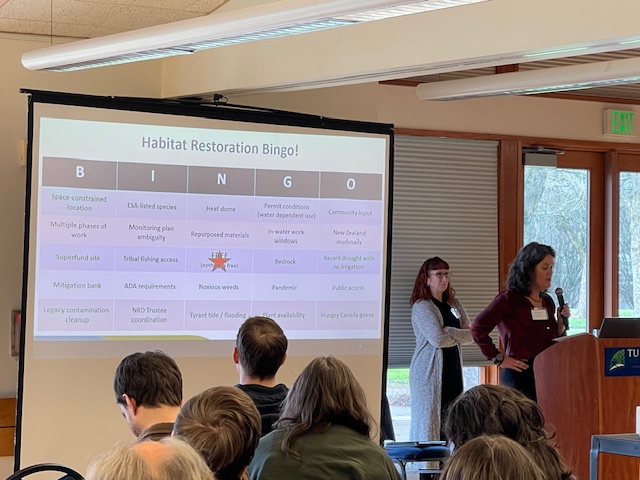
A duo from the Port of Seattle livened up their presentation with “habitat restoration bingo,” underscoring how everyone in the room was dealing with similar challenges and triumphs.
The sites discussed at the gathering were along many miles of the Duwamish/Green River, from its mouth on Elliott Bay deep into the southern reaches. That’s where another presentation was focused, a six-acre site that had hed a rundown hotel, demolished 10 years and yielding 250 tons of asbestos. Lessons learned from that site: Don’t put wood where it doesn’t belong; the fish weren’t interested; the choice of restoration materials is important Also, be ready for surprises – they discovered a significant amount of stormwater drainage that had to be rerouted. Here, like other sites, they had to work on repelling geese – they even took over a pole that was meant for osprey.
Now, after a few years. the plants are growing well, and an ecologist who grew up in the area says it’s “magical to see … important and valuale to bring all that nature right to where people see it all the time.” (This site has some noise challenges, though – it’s in earshot of a rifle range.)
Back toward the north, a West Seattle site just south of the former T-105 Park (now known as t̓uʔəlaltxʷ Village Park and Shoreline Habitat), is owned by a subsidiary of Nucor (WSB sponsor), and its restoration project is in construction right now, almost complete. Past and present photos were shown:
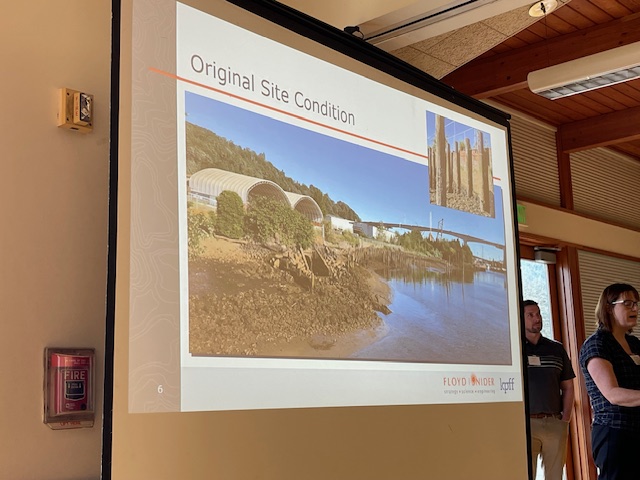
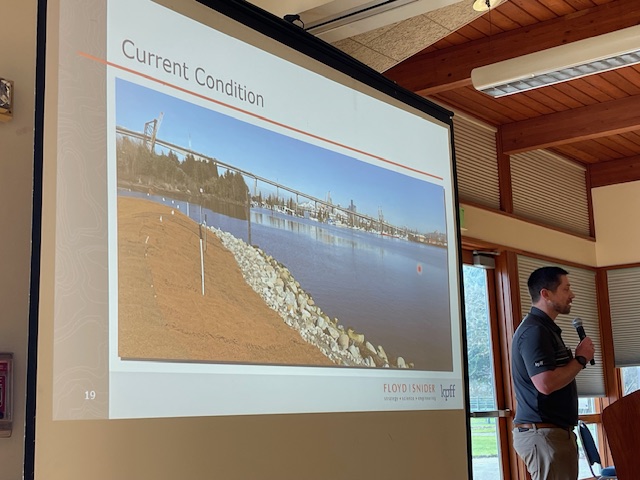
The challenges on this site range from creosote pilings to a rail line that takes scrap steel to Nucor and has had “some past derailments,” the symposium was told. They had to “clear 3 1/2 feet of contaminated fill” and remove a steel bulkhead, eventually resulting in almost three acres of habitat area, half of it “intertidal.”
The firm KPFF worked on this site as well as the aforementioned Vigor site and said the two were “really different” – among other discoveries, they found “an old concrete bunker filled with cable and a “huge outfall … draining a large part of West Seattle.” This presentation was one of several that mentioned another common challenge – boaters that don’t observe the speed limit and therefore churn up wakes that can damage the restoration zones.
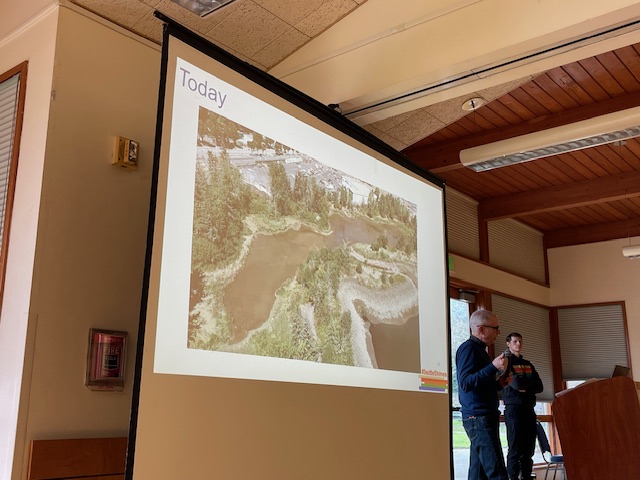
Also on the West Seattle stretch of the river, two Seattle Parks reps, David Graves and Matthew Hilliard, talked about one of the earliest projects, at
Herring’s House Park (Tualtwx) – you might recall Graves from West Seattle projects including the restoration of shoreline at Lowman Beach. He said it was important to recall “there was a place here” before there was a park. The siute includes “the last remaining oxbow on the river,” he added; the Duwamish was once a winding river before it was straightened in the name of industry. The city took over the site in the ’90s and took on a 17-acre restoration, 11 of the acres intertidal, 6 upland, completed in 2000.
The fish, however, haven’t been so interested in using this habitat, they said, so the question now is, how to make it better? They’ve hired a consultant for a feasibility study.
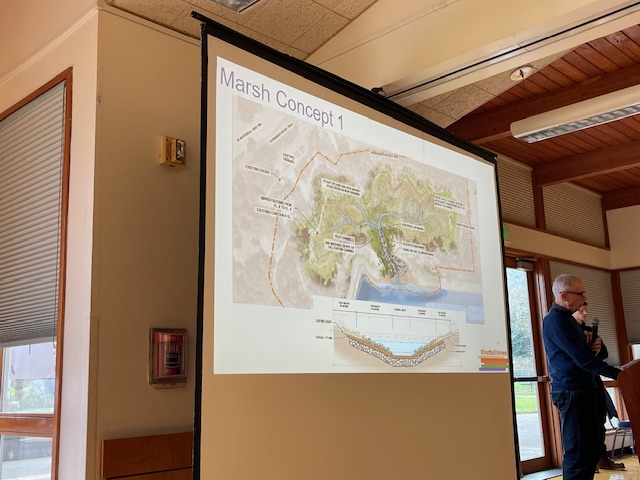
With all that, they’re at 30 percent design on projects; they’re planning for a “loop trail” to replace the “social trail worn throughout the years,” noting they’ve tried to “discourage” it over the years with fencing but that had been “destroyed three times” before they finally gave up. Park users also have put up problematic signs, Hilliard noted, such as “no minors.” In non-human challenges, the parks pair echoed others regarding geese. “You’ve got to goose-proof your plants or they’re going to be decimated.”
Back down to the Tukwila area, Mike Perfetti from the city spoke about two habitat-restoration projects, the Duwamish Gardens – near the mentioned-earlier Chinook Wind site – and a flapgate-removal project on Riverton Creek. The Duwamish Gardens site was an “abandoned derelict farm” (backstory here) bought by the city for a park. The cleanup required here was traced back to chemical contamination from years of farming, including DDT; cultural resources had to be respected as well. They had to excavate 30,000 cubic yards; 1,000 yards of that were able to be reused as a viewpoint.
One thing notable about this presentation – it was a reminder that some restoration sites include public access, some – mostly because they’re on an industrial site – do not.
The Riverton Creek project was aimed at restoring salmon access into the creek, by taking out flapgates and culverts, requiring many agreements and easements to work out. But in the end, the stream was daylighted and the shoreline restored. And – the fish are back.
One last jump back to the north: Duwamish River People’s Park and Shoreline Habitat, the Port of Seattle-owned site in South Park. This higlighted another point common to some presentations – the process of acquisition, cleanup, and restoration often takes many years; in this case, the port acquired the site in 2000, it was cleaned up 2012-2014, and park construction was 2020-2022. Now they’re in a “monitoring” phase that will continue until 2032.
Here, they built a sort of “macrame” fence to exclude geese, who had even kicked out nesting ospreys. Here too, the fish are back – far more chum than chinook – and the chum draw other predators, like river otters. Another challenge: South Park’s “king tides,” although the habitat features survived them.
Even for a layperson, the day was a fascinating peek into what it’s taken to try to bring stretches of “Seattle’s only river” back to life.
WHAT YOU CAN DO: Help with habitat restoration!
 (WSB photo, spring 2024 Duwamish Alive!)
This spring, for example, you can join the Duwamish Alive! Coalition – which organized the symposium – at the twice-yearly, multi-site work party that will show up here soon.