
By Torin Record-Sand
Reporting for West Seattle Blog
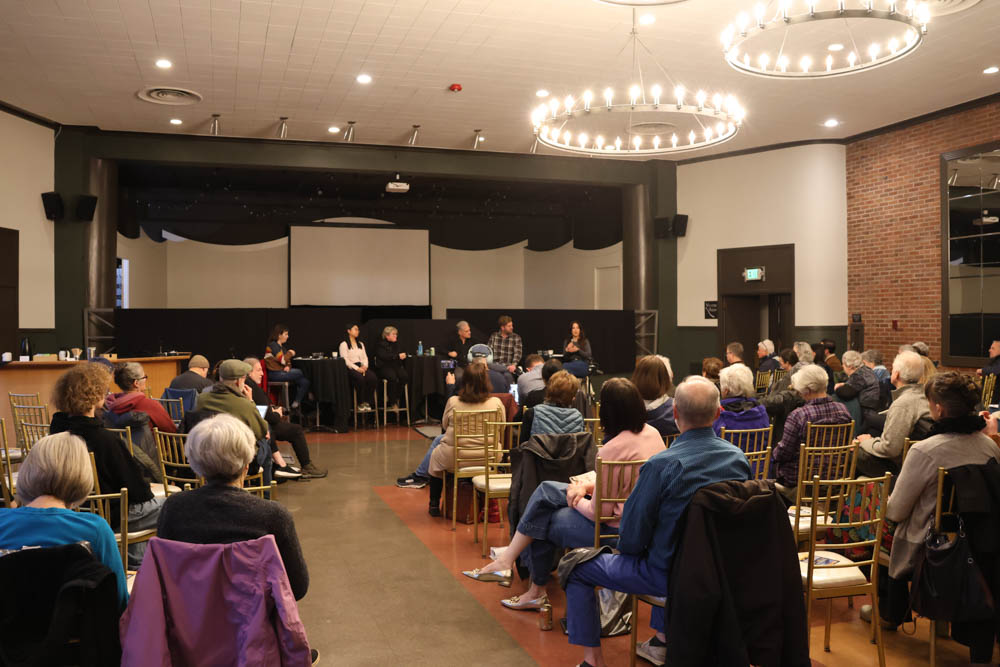
In the wake of violence during immigration enforcement in Minneapolis, Los Angeles, and Chicago in recent months, many community groups have stepped up to ask the question: What could we do if it happened here? This was the topic of discussion during the pre-meeting program at the 34th District Democrats‘ March gathering; they invited five community organizers to speak about what they’ve learned from the past few months, and how they can apply it to organizing community-driven non-violent resistance here.
Chief among these organizers was Kenny Austin, who assembled Wednesday night’s panel. He recently created the 34th DDs’ Non-Violent Resistance Committee, which aims to research the best way to conduct such activity in the district. Joining him on the panel were Binh Truong, general manager of fieldwork for Common Power; Emily Gaggia, director of the “adopt-a-corner” campaign for the National Day Laborer Organizing Network; Laurie Reinhardt, co-founder of West Seattle Indivisible; and Devin Hermanson, founder of Defund Musk.
The panel was moderated by veteran Seattle journalist Erica C. Barnett, founder and publisher of online non-profit news publication PubliCola.
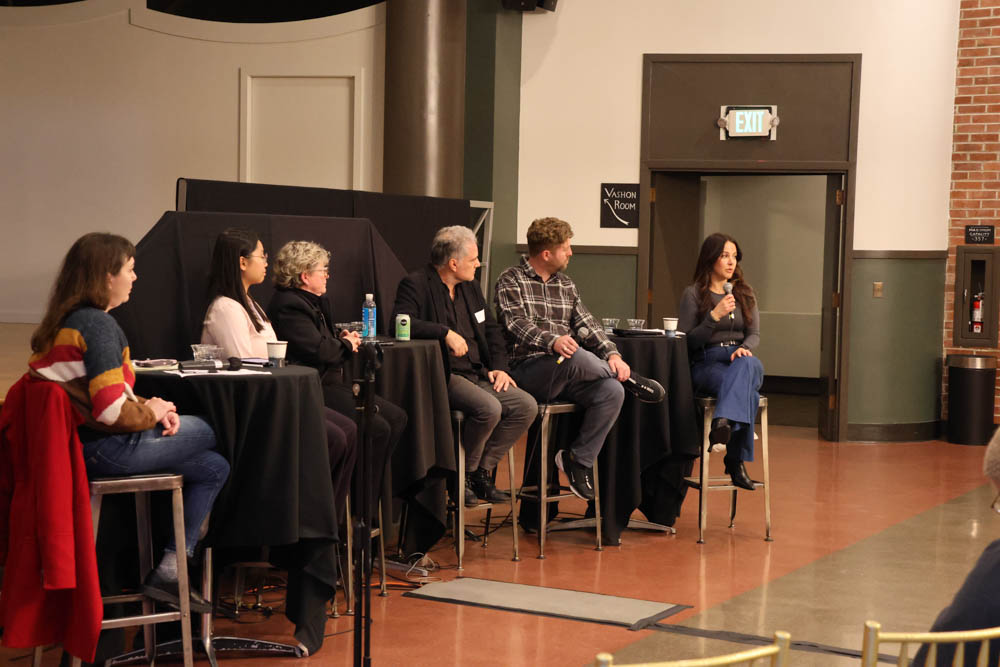
The overall question which seemed to hang in the air in back and forth between Barnett and the panelists was the relevance and results of protests by community organizations. One of her first questions regarded what advice the organizers would give for people interested in getting engaged in projects aiming to help people directly targeted by the administration.
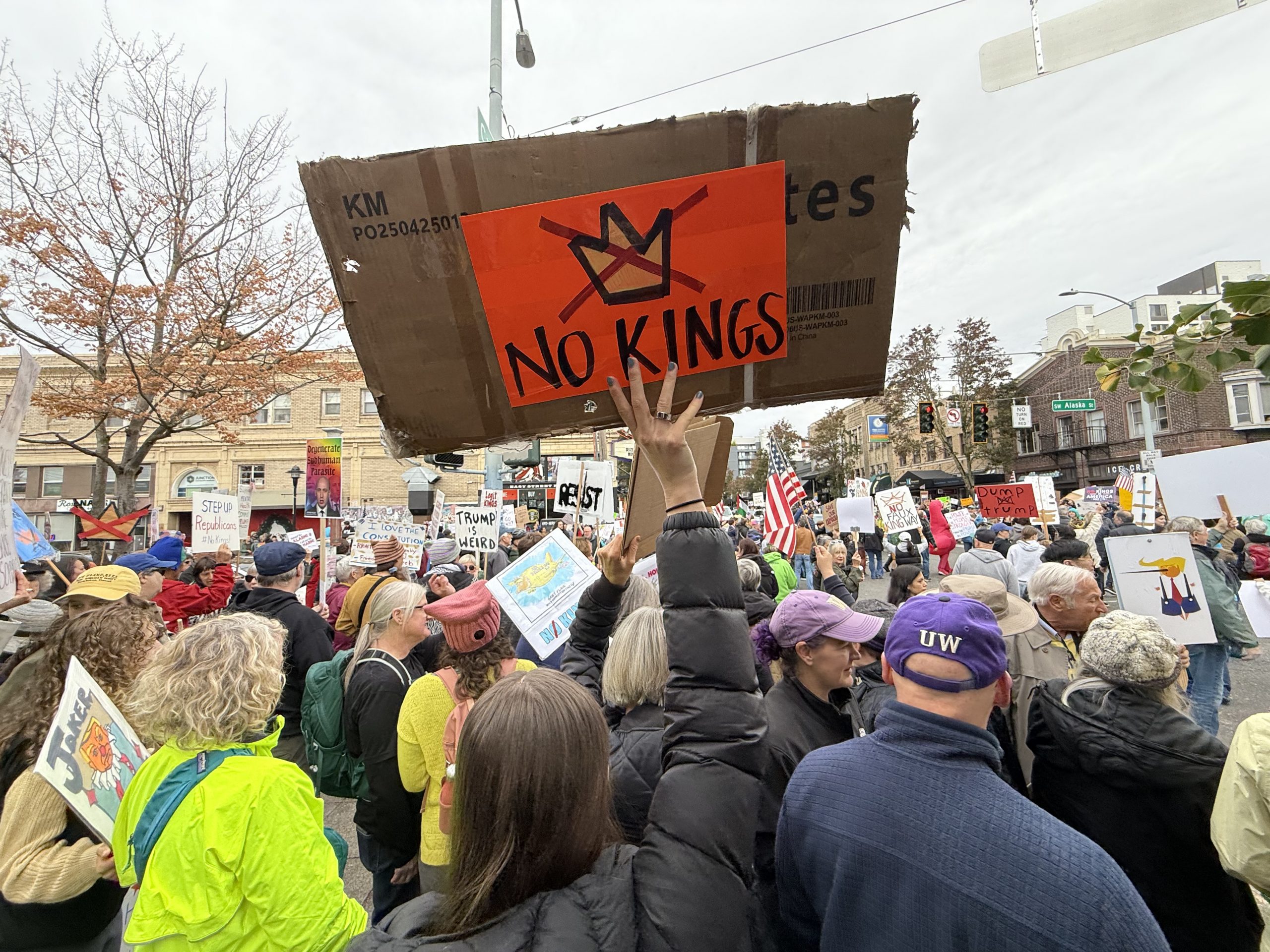 (Reader photo, ‘No Kings’ protest in WS Junction in October)
“Sometimes it’s like ‘are we doing anything?’ I’ve read tons of snarky comments on social media etc critiquing No Kings [protest theme], asking what is it really doing? It’s doing so much. I’m the guy that takes emails, I get emails all the time, people saying ‘Wow, I haven’t come out yet, and I’ve been kinda quiet, but I drive by and see you and your signs every week and it gives me hope.’ Sometimes those people come and they stand next to us with their signs, and it’s beautiful. That’s how we build community and give someone a chance to come into it.” said Hermanson.
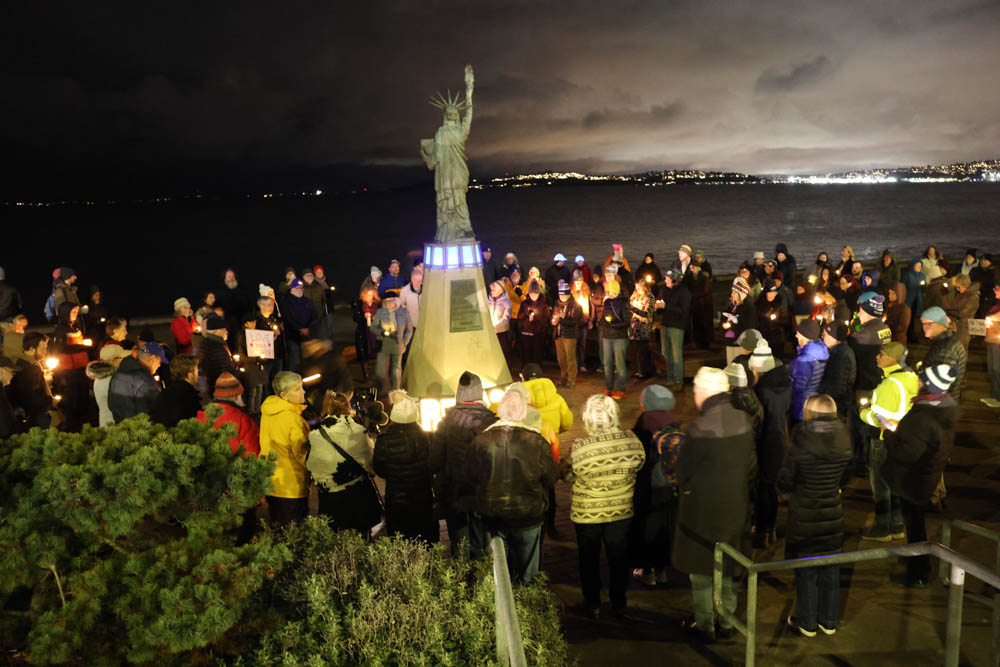 (WSB photo, January vigil organized by WS Indivisible)
Reinhardt seconded that one of the most important aspects of local activism is a sense of communal belonging. “There are people I call ‘on the couch,’ they are politically motivated, but not inclined to do something. And they are awash in despair, with the flood of what we’re getting every day – but the people I interact with – […] I don’t see that despair among people who are in the movement, we are joyful, we are happy, we are engaged, and united on a very hyper-local level.”
“If there’s one thing I’d add – when I hear some naysayers asking what does a march to do to help people – it shows people you care about them, you support them, especially migrant communities. It’s a powerful message to let people who are afraid know there are people who have their back.” said Austin.
The conversation turned toward the more pressing matters which organizations such as Austin’s are aiming to tackle, such as persistent fears that the Trump Administration may hamper midterm voting in multiple states. Barnett asked the participants what they would do to prevent such a thing.
While a few participants concurred that Washington state voting rights are not as endangered as those in some other states, they still said that there were ways to help, and threats to worry about. A persistent theme was making sure to help neighbors get to voting sites, as well as watch for potential interruption in such sites. (Austin noted the 2024 ballot-box arson in Vancouver, Washington.)
“If you can’t go out of state to [volunteer in organizing for states with worse voting rights], something you can do here is protect your neighbors – if a neighbor is afraid of the polls because of the law enforcement, you can help them get there and look after them.” said Truong.
Barnett closed the panel by asking what was giving the participants hope to push forward in their efforts.
Many of the participants said that simply seeing the community engagement that has come out of recent protests has given them the strength and mental fortitude they need to continue in their work. “One of the things that gives me the most joy and the most hope is to watch large mobilizations actualize […] each time [we go out to protest], the numbers have grown. […] When all you can see is heads in every direction and you’re talking to one another, and you’ve got a common vernacular, common position and perspective on the world today, you can just stand there and feel it – that gives me hope.” said Reinhardt. “If someone asked me a year ago if we were gonna see people out in the streets saying ICE out for good, 3 years ago that wasn’t there, 4 years ago that wasn’t there. [Now, seeing this response], we were dumbfounded, there were many tears shed. That keeps me sane.” said Gaggia.
34TH MEETING, POST-PANEL: After the panel concluded, the 34th conducted their more organization oriented business. These included items such as amendments to the bylaws for special elections, the appointment of a new Precinct Committee Officer (Megan Atchinson), and their future platform for the year. Notably, this last item reflected some of the same concerns that were raised in the panel: A relatively new member of the 34th objected that the platform did not include a section specifically on advocacy for immigrants’ rights. Other members agreed, and their upcoming platform will go back for further revision and deliberation at the next meeting.
They closed with a few announcements. Their upcoming 2026 fundraiser will be taking place at the recently opened White Center HUB on May 30th, between 6:30 to 8:30 PM. Their next organizational meeting will be on April 8th, and will feature tabling from local organizers in the district, organized in association with the West Seattle Joiners. As the next meeting gets closer, you’ll find more information online at 34dems.org.