(Seattle Channel video of committee meeting; Vision Zero item starts 35 minutes in)
By Macey Wurm
Reporting for West Seattle Blog
SDOT‘s chief safety officer says so far this year, things are safer on Seattle’s streets.
Not safe enough, says District 1 Councilmember Rob Saka. The committee he chairs – Transportation, Waterfront, and Seattle Center – had the Vision Zero safety progra on its agenda this past Thursday, including a review of 2025 data and an overview of planned projects for 2026. The meeting was the day after Saka called for an audit of the program, as we reported here.
Addressing the audit during the committee meeting, Saka said, “Vision Zero is about saving lives and while we are seeing some real progress the tragic reality remains that too many people are still dying and suffering serious injuries on our streets.” He also called for a moment of silence for the two people killed in a wrong-way crash on Highway 509 south of the city last weekend.
Funding for Vision Zero and other safety initiatives is part of the eight-year $1.55 billion Seattle Transportation Levy passed by voters in 2024. The presentation during Thursday’s meeting was given by Venu Nemani, SDOT’s Chief Safety Officer and City Traffic Engineer.
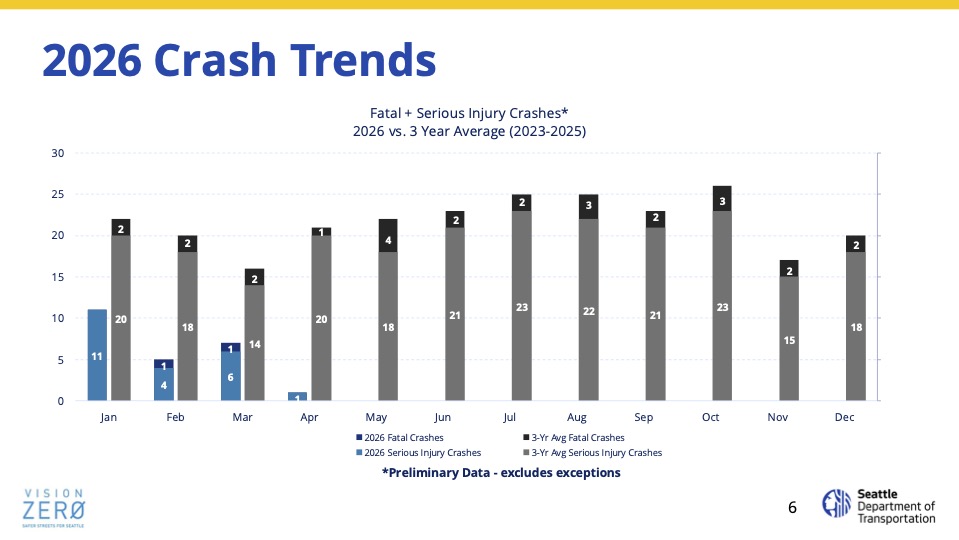
He noted that the first quarter of 2026 has brought fewer fatal collisions and fewer serious injuries compared to an average number from the past three years, and introduced some planned projects for the upcoming year.
These include four levy-specific deliverable goals– “safety upgrades on up to 12 corridors across the city, 40 high-collision locations, arterial traffic calming on 50 corridors, and pedestrian head-start signals at 280 intersections. Nemani added that a plethora of projects have been planned even in light of the construction timeline barrier provided by the FIFA World Cup coming to the city this summer.
Both Saka and citywide councilmember Alexis Mercedes Rinck voiced concern over SDOT improving their response timeline to traffic incidents involving fatalities or serious injuries. Saka wondered whether a 72-hour response model similar to that currently used for filling potholes could be implemented to make “immediate remediations” at collision sites.
Nemani explained that this would be difficult because it often takes much longer for SDOT to receive a police traffic-collision report – which is necessary for the department to fully understand the nature of the crash before beginning safety improvements.
“But I do understand the underlying need to have a more rapid response at locations that have had fatal collisions. I still don’t have all the specifics to share with you, but it is something that we are closely looking at,” Nemani said.
Councilmember Saka also addressed public comments that he heard at at the start the meeting, including what he called an “inference” that the city needed more bus lanes, bike lanes, and pedestrian-friendly improvements. He responded by declaring that he “fundamentally disagree(s)” that elected officials should “somehow be responsible for approving every safety project.” He noted the “Curby” controversy as an example, in which he was criticized for a $2 million proposal to remove a Delridge Way median preventing left turns to a preschool: “Every time that I’ve intervened in specific design decisions hasn’t gone too well. Even when I’ve fought for immigrant and refugee communities or kids, daycares, working families, some people have lost their natural minds. Even when we landed on a compromised solution to save Curby, still engendered passionate feelings.” Saka said.
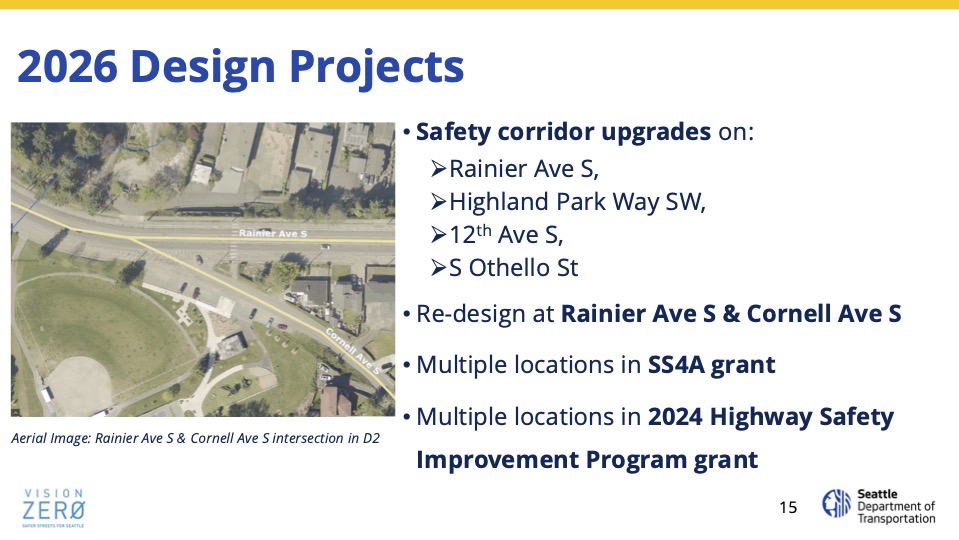
The only West Seattle project mentioned in Nemani’s presentation (here’s the full slide deck) – and briefly, at that – was the plan to convert the outside downhill lane on Highland Park Way to bicycle and pedestrian space: