
By Macey Wurm
Reporting for West Seattle Blog
In West Seattle’s High Point neighborhood, 81 percent of youth say they have witnessed or heard gun violence near home or school in the last six months. Additionally, 70 percent of parents and caregivers keep their children inside and limit activities out of fear related to gun violence.
These findings came from a survey of 42 youth and 20 parent and caregiver respondents conducted by Fahima Mohamed, a High Point resident and student at the University of Washington. On Tuesday, Mohamed presented the results, alongside responses to other prompts, as a way to gauge community sentiment surrounding increased gun violence.
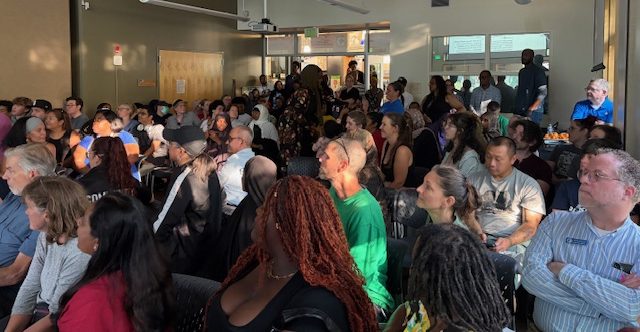
Neighbors, friends, and strangers filed into High Point community hub Neighborhood House on Tuesday, prepared to discuss current efforts and actionable plans to address the increase in recent months. The well-attended gathering, titled “It Takes a Village,” was organized by Mohamed.
“One of the big reasons I wanted to have this space and for everybody to come together is so that the leaders in the community can talk about the work they’re doing.” she explained.
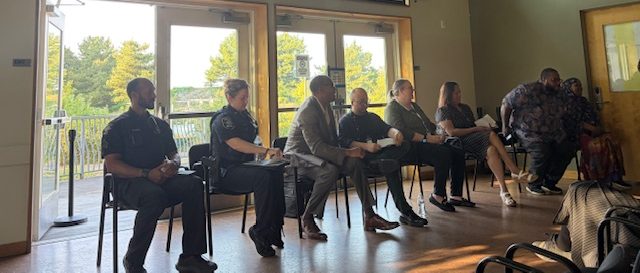
The meeting lived up to its name. Panelists from the <strong>Seattle Police Department, Seattle Public Schools, Seattle Housing Authority>, Neighborhood House, and parent representatives established a sense of collaborative accountability. They acknowledged their individual responsibilities in preventing future gun violence and responding to those already affected.
Mohamed presented questions based on her survey findings to the array of panelists, who conveyed their responses to the audience.
Police Response and Violence Prevention
Southwest Precinct commander and panelist Capt. Krista Bair emphasized plans for “directed patrol” (as she had at last week’s Our City, Our Safety meeting). She shared that research suggests 20 minutes of police presence in hot spots generates 90 minutes of deterrence. High Point was already on the calendar for directed patrol prior to the August 10th murder; Bair promised that these plans would be enacted.
SPD’s response tactics were discussed iafter a question posed by Mohamed about consequences for repeat offenders in gun-related incidents. Panelist and Officer Matthew Roberson explained that the department shares information about offenders with community organizations that try to interrupt violence.
He mentioned a partnership with Southwest Youth and Family Services, which conducts followups with individuals, and SPD’s Community Service Officers, who connect offenders and those affected with additional resources.
Another SPD initiative highlighted by Capt. Bair: Twice-weekly “gun calls” on Mondays and Thursdays. The meetings are held in collaboration with city attorneys, other precinct captains, youth prosecutors, and the Department of Corrections to discuss gun violence occurring since the last meeting, and to share information about repeat offenders.
Ted Howard, Seattle Public Schools’ Chief Accountability Officer, introduced another preventive tactic, specific to SPS: A new protocol rolling out this school year called “SaferWatch.” The app is a federally funded platform that offers medical reporting, anonymous tips, and schoolwide communication. Tips are routed anonymously to trained professionals who then forward them to appropriate responders, according to Seattle Public Schools’ website.
Howard explained that the app will allow students to report potential instances of planned violence or threats, preventing dangers like fights or weapons on campus, before these events occur.
Infrastructure Fixes
Another preventive inquiry conducted by Mohamed involving the Seattle Housing Authority, which manages the High Point area, regarded lighting and camera installation on 30th Avenue as well as other hotspots for activity. SHA explained that 3 of their 100 lights in the area are currently out and said they are in the process of repairing. As for increased surveillance cameras, they would like to implement more, but need funding to ensure added cameras could fit in their budget.
Mental Health Resources for Students
Ted Howard explained that SPS works to identify students who may be in need of mental health resources through surveys, “tell a buddy” prompts, academic writings, and journals.
“One of the things we try to do at SPS is to be a conduit to bridge those supports in place. We don’t hire teachers or counselors to do mental-health counseling, but we try to make sure students that need help, that they get identified and get that resources to them.”
West Seattle Elementary’s new principal Stephanie Barragan built upon this sentiment. She highlighted the school’s renewed partnership with Atlantic Street Center behavioral-health services and two in-house therapists: “As much as our families are saying it starts with home life, the reality is once school starts, students are with us for seven hours a day. We have that responsibility too.”
Community Response
Throughout the meeting, emphasis was also laid on how the aforementioned organizations can work together to ensure the future safety and well-being of High Point’s children and families.
“All the organizations in the room, I think it’s our next step, our inspiration, to be more connected, for our youth so that things line up for our kids, so they’re not disjointed, and I think that we have the opportunity to do that in Seattle in ways that could be truly transformational,” said Jeff Clark, former principal of Denny International Middle School.
This notion of collaboration was extended not only toward organizations represented amongst the panelists, but to community members as well.
“Your community is not going to change anything if you come and have these community meetings and walk out and don’t take action. You got to get to know not only your students, but you got to get to know each other as you hold each other accountable, then you’ll start to see your community shift and change,” said Howard
As for what’s next, Fahima Mohamed laid the groundwork for a future of camaraderie and progress. She suggested a quarterly check-in hosted by Neighborhood House, monthly parent gatherings involving youth activities and a parent group advisory on safety, and a Friday tea time for community members to gather and discuss.
“I really have hope in the collective troubleshooting and the collective solution finding,” concluded Shak Sanders of Neighborhood House.