
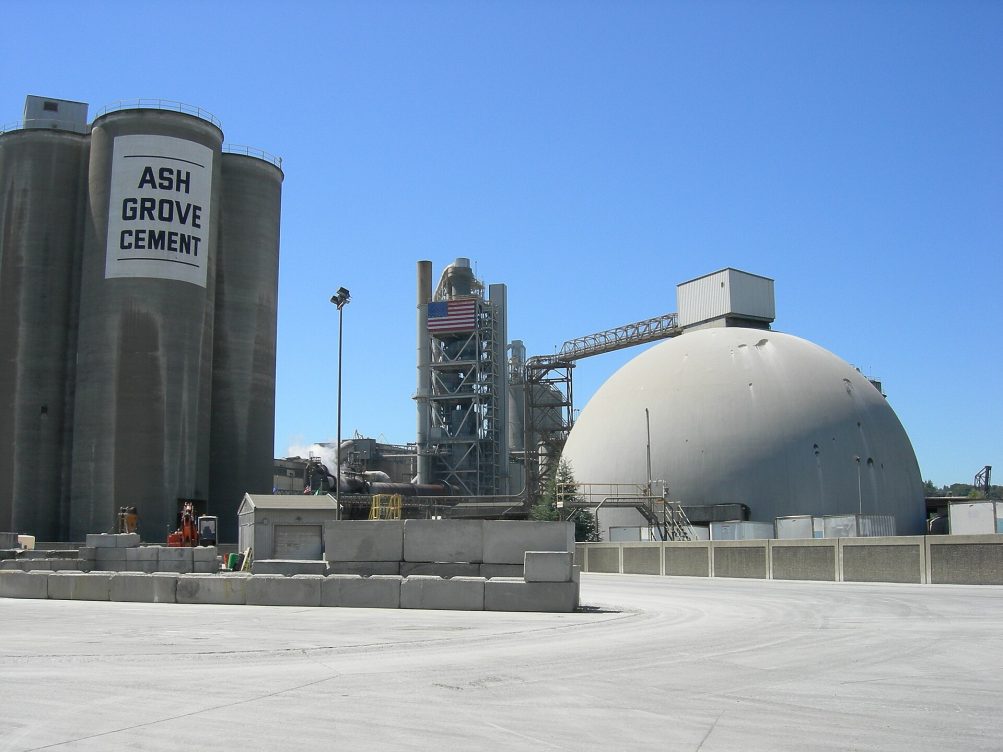
 (Wikimedia Commons file photo by Jmabel)
The Duwamish River Community Coalition says it’s succeeded in its longrunning challenge to the Ash Grove Cement plant – just south of the West Seattle Bridge – seeking to burn tires at a faster rate. From the DRCC’s announcement:
The Duwamish River Community Coalition (DRCC) has won their two-year battle against the Notice of Construction (NOC) Permit issued by the Puget Sound Clean Air Agency (PSCAA) for the Ash Grove Cement Company (Ash Grove). The NOC permit would have removed the 30% limit on the tire-burning rate at the facility; records show Ash Grove would have combusted up to 3.7 tons of tires (about 43% of total fuels) per hour to heat their cement kilns. Due to high metals emissions that would have resulted from this change, PSCAA reinstituted the 30% cap on tire burning. The reversal stems from years of advocacy and litigation by DRCC and Front and Centered, as well as results from heavy metals testing requested by the community.
Tire burning releases particulate matter, heavy metals, and hazardous air pollutants known to harm human health in many ways, including respiratory and cardiovascular diseases, cancer, and other chronic health problems.
As a frontline community, the Duwamish Valley is already disproportionately exposed to higher rates of air pollution resulting in serious health impacts. Some of these impacts include the highest rates of childhood asthma hospitalizations in King County and a life expectancy ten years less than other neighborhoods without these exposures, like Laurelhurst, only ten miles away.
Over 500 community members and 30 local businesses joined with DRCC, Front and Centered, and Earthjustice in strong opposition to the permit during the public comment period. Community members also led a protest in front of PSCAA headquarters in November of 2025, demanding their health be prioritized and the 30% limit remain in place. Despite this community advocacy, PSCAA issued a Final NOC to Ash Grove that eliminated the cap on burning tires at Ash Grove’s Seattle facility. In January 2026, DRCC and Front and Centered filed an appeal before the Pollution Control Hearings Board challenging that notice of construction order. Because PSCAA has reinstated the 30% limit, DRCC and Front and Centered dismissed their appeal.
“In frontline communities like the Duwamish Valley, any increase in air pollution is unacceptable, and should be faced with the highest level of scrutiny,” said Paulina López, Executive Director of DRCC. “For too long, communities like ours who already bear a disproportionate share of environmental harms have also been forced to shoulder the responsibility of monitoring neglectful government decisions and advocating for our health.”
By issuing a final permit that allowed for increased tire burning without instituting measures to control the corresponding increase in pollution, decision-makers at PSCAA failed to take seriously community concerns that have ultimately been proven true.
DRCC and the community’s advocacy led PSCAA to add a condition to the Final NOC permit (issued Dec 2025) that required testing for hazardous air pollutants – arsenic, beryllium, cadmium, chromium, lead, manganese, nickel, and selenium – following the increase in the tire-firing rate. If the testing showed an increase in emissions of any pollution, the previous 30% rate would remain in place.
In June 2026, Ash Grove conducted the required testing, and results showed an increase in cadmium air pollution from Ash Grove’s increased burning of tires. Cadmium is a Class-1 carcinogen, known to cause lung and prostate cancer, and bioaccumulates in the kidneys and bones, causing kidney damage and bone demineralization. As a result, PSCAA reinstituted the 30% limit on tire combustion, to prevent an increase in metals emissions.
“Without the overwhelming outcry from the Duwamish Valley community, DRCC, and our partners” said Mia Ayala-Marshall, Clean Air Program Manager at DRCC, “PSCAA would have allowed this modification to occur without proper testing, further exposing our community to more dangerous air pollution that impacts our health.”
The news release also says they are urging advocacy for legislation that could prevent similar situations:
Under Washington’s current laws, permitting processes do not require polluting businesses to consider the effects of historical environmental racism and the cumulative health risk burdens that Frontline communities face. Legislation like the CURB Pollution Act is an important next step in ensuring that our communities have the healthy environment we all deserve.
DRCC – whose clean-air advocacy is detailed here – and Front and Centered say they voluntarily dismissed their appeal today. (Here’s the document.) We’re seeking comment from Ash Grove, which has operated the Seattle plant for more than a century.