
By Macey Wurm
Reporting for West Seattle Blog
“There are folks who are climate deniers, and there are folks who are climate alarmists. The alarmists think that we’re going to be ending humanity in the next 25 years, which is not going to happen. We’re going to adapt.”
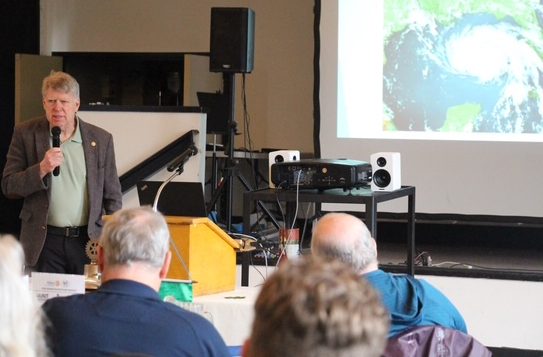
This was an assertion made by this week’s Rotary Club of West Seattle speaker, Dave Spicer. Spicer, a Rotarian for 40 years, is currently serving as chair of Rotary District 5030’s Environmental Sustainability Committee; he has done extensive work through Rotary on 57 water projects and humanitarian aid trips. (Here’s more on his background.)
His presentation covered all things environment – situating the audience in our current situation, both locally and globally, and delving into widespread environmental issues before beginning to discuss potential mitigation strategies, and wins.
Spicer outlined the fundamental reason that climate change is happening: the release of fossil fuels into the atmosphere. He explained that methane gas and carbon dioxide are working together to contain heat within our atmosphere, after which he explained the physical effects.
In our state, he noted, Washingtonians are experiencing flooding and water scarcity simultaneously, in different regions. A drought has plagued Eastern Washington for 4 years, while some Western Washington residents experienced extensive flooding in December, damaging 4,000 homes, leading to the evacuation of 100,000 people.
On a global scale, a lot of the damage outlined by Spicer concerned oceans, especially damage to coral reefs, which provide a habitat for 25% of the marine population. He called the potential for the coral reefs to continue on this trajectory as “quite cataclysmic”. The Ph is also lowering in the ocean due to warming, and concern lies in how this temperature rise will affect the frequency of hurricanes and marine life in general.
He then moved to outline how this environmental deterioration has had, and will continue to have, an impact on man-made societal structures. Insurance and deductibles for businesses are going up because of the increased risk for destruction of property due to extreme weather events – weather events that result in at least $1 billion in property damage. The damage from the floods in December was estimated at more than $182 million, for which Governor Ferguson submitted a request for federal help.
Climate change has also had an impact on human health issues, Spicer said, including potential risks for people with respiratory issues and higher risks for skin cancer in extreme heat. He also referred to the term “Climate Trauma,” saying it has emerged in mental-health spheres as a diagnosis.
As it may read now, Spicer acknowledged the anxiety-inducing nature of our current climate crisis. “I don’t mean to be overwhelmingly sobering… but I do want you to have a sense of the trajectory,” he said. “There are a lot of positive trends. Renewable energy is in many countries, including our own area and other parts of the country; [these energy sources] are really on the increase, primarily air and solar.” He emphasized the importance of nuclear power, noting that currently 10 percent of Washington State’s power is nuclear.
In the legal realm, Spicer brought up the Inflation Reduction Act of 2022, which incentivizes industries to move forward on the use of solar and wind power, and encourages the transition to domestic energy sources. Additionally, a 2024 Montana Supreme Court ruling upheld a landmark climate ruling concerning state residents’ constitutional right to a clean environment.
On an individual level, Spicer gave advice on several actions people can take to reduce their own environmental harm. These include taking a carbon-footprint test, educating yourself about climate change, and smaller individual actions such as turning temperatures down at night, taking shorter showers, using electric vehicles or public transit, among other suggestions.
“It’s not going to go away, It is going to get worse, but we can mitigate it. Spicer said. And there’s potential for all of it to play a role for our children and our grandchildren, because 50 or 100 years from now, if you don’t do enough, you will have let them down. That’s the reality.”
After those closing thoughts, Spicer answered three questions, all that organizers said time would allow.
The first question was about concern over the current administration’s disengagement with national and international climate matters. “What will be the impact of our dismissive attitude over four years?”
Spicer began by noting that the United States is home to some of the “best creative entrepreneurial energies, some of the most incredible scientists, and some of the finest people in this field.” He added that these people are now being limited in their involvement to be part of the solution. “Those regions like ours that are richest have to figure out a way to support those that are most impacted.” Spicer emphasized that since our country helped to create this problem, we have a responsibility to come to the aid of those most affected by it.
The second question acted more as a statement, expressing concern over the direct impact of fossil fuels on nations and wars. The Rotarian said, ‘We’re going to have more of that if we don’t wean ourselves off oil,” to which Spicer agreed.
“We can’t extricate gas overnight,” he said. He talked about the necessity to develop a plan for the next 20-30 years to transition to solar, wind, water, and nuclear power. “It just absolutely has to happen, frankly.”
The last question pertained to Rotary members specifically – whether a Rotary program exists to educate populations about the impacts of climate change who don’t necessarily acknowledge it. Drawing from his extensive experience as a Rotary member working around the world, Spicer observed that the last 10 years have been “mind-shaking” for most people. He explained that most Rotarians understand the extent of the crisis, specifically mentioning branches in Asia and Africa who diligently take care of their ecosystems.
SIDE NOTES: One Rotary member recommended the book “Parable of the Sower” by Octavia Butler to learn more about what a country in a water crisis looks like. Another mentioned extensive New York Times coverage on the Thwaites Glacier in Antarctica and the effects of its dwindling.