
By Macey Wurm
Reporting for West Seattle Blog
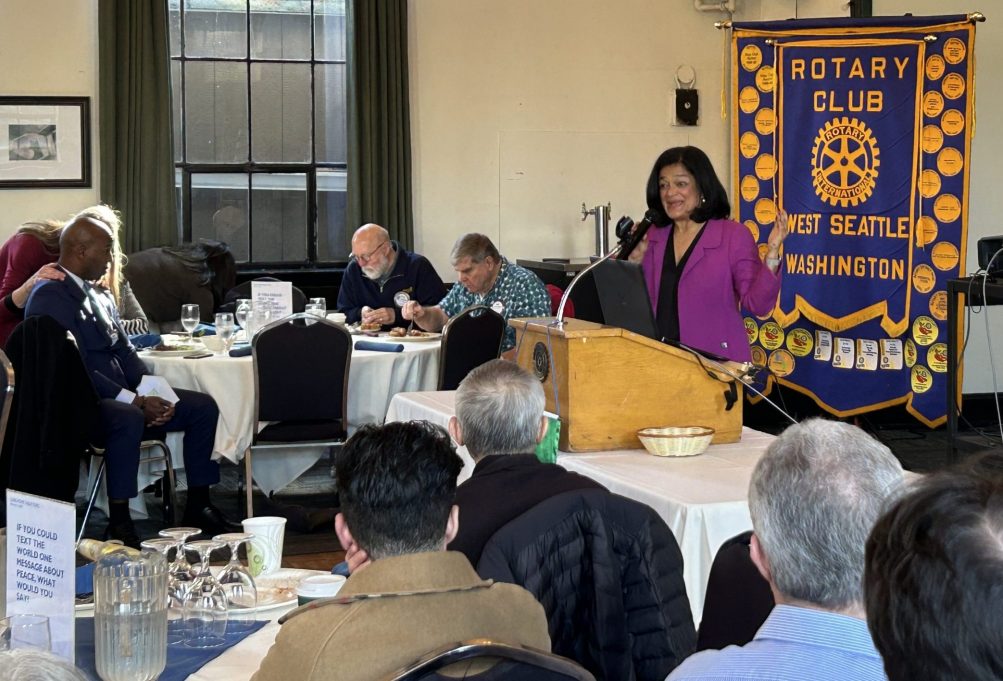
The Rotary Club of West Seattle hosted West Seattle’s highest-ranking elected official at this week’s lunch meeting.
U.S. Rep. Pramila Jayapal, who lives in West Seattle when not in D.C., has represented Washington’s 7th Congressional district since 2017. District 7 encompasses the majority of Seattle and the neighboring communities of Shoreline, Vashon Island, and Lake Forest Park.
Jayapal arrived after the Rotary’s lunch had concluded on Tuesday to speak about the current state of national and local politics, as well as welcome questions from members. She began by saying that her favorite part of the job is being home in order to engage with people residing in the district she represents. She wanted to highlight the work that she does on a hyper-local level to the Rotary because she felt that so much of the public focus otherwise is on higher-profile issues that she works on – like immigration and the Epstein Files.
The congresswoman said she has secured around $18 million for projects across District 7 in the past year dealing with transportation, arts and community, food banks, and housing. She said with regret that the current administration has only allowed these funds to support government projects and not nonprofits. She also said she has delivered 22 acres of new “parkland and community gathering space” to the district.
Regarding the Epstein Files, she said she has been working on exposing “powerful rich predators who were part of a massive global sex trafficking ring and have not been brought to justice.” Rep. Jayapal has collaborated with Epstein survivors, interviewing four of them for her podcast “The Power You Have,” which has another episode coming out this Friday. “It troubles me so much, it sickens me, really. It’s just a level of depravity that I’m finding it hard to find the words to express.” Jayapal gave immense credit to the survivors for “shaking the earth,” and is hoping that the resignations happening with prominent figures involved globally will soon begin in the United States.
Immigration reform was mentioned as well, with Jayapal describing the violent detention of both American citizens and undocumented immigrants as “bipartisan horror.” She noted that more than 76,000 people are currently incarcerated in for-profit immigration-enforcement facilities, or “jails” as Jayapal calls them because of what she describes as horrific conditions. She also mentioned how the partial government shutdown is affecting the Department of Homeland Security, saying she is pushing for significant reforms to be required if funding is to continue.
On the topic of bipartisanship, Rep. Jayapal pointed to her co-sponsorship of the Restore Trust in Congress Act. The bill would effectively ban members of Congress from owning or trading stocks, but is competing with a recent bill announced by speaker Mike Johnson which addresses stock trading, but doesn’t ban it entirely. She wanted to mention bipartisanship in a couple additional lights – the collaboration for humanitarian efforts in Sudan, and work in Syria to bring a true democracy.
After these notes, Jayapal opened it up to questions from Rotary members, of which there were many, but time only allowed for five.
Question 1
“If you could spur the citizens to do something to help the current situation, what would that be?”
“Speak out,” Jayapal replied. She urged listeners to use whatever platform they had access to to speak on important political issues, and importantly, to bring “as much legitimacy to what you are saying as possible.” She also advised people to get involved with organizations such as the ACLU and the Washington Immigrant Solidarity Network, as well as to participate in mutual-aid assistance for Minnesota. “Hopelessness and powerlessness are tools of an oppressor,” she warned.
The congresswoman polled the room for individuals who had taken her Resistance Lab training. The training is aimed at giving the public precise tools and tactics to help resist against a dictatorship.
Question 2
“What is your solution to the homelessness situation?”
Jayapal talked about her bill, the Housing is a Human Right Act, and explained her belief that “everything starts with having a home.” She said the federal government has disinvested in housing over the years, and that affordable housing is essential to combatting the crisis. Specifically in Seattle, she brought up that private equity investors are contributing to the growing number of empty units, by purchasing units that were previously available for rental. “Poverty and homelessness are failures of policy, not people,” she said.
Question 3
“What does the restoration of public health look like?”
Jayapal explained the consequences of the destruction of data sets at the federal level. “Federal data sets that track epidemiology of a disease emerging no longer exist, they have been scrubbed. Rebuilding is going to be a very difficult and long process, long after RFK Jr. is out of office.”
She emphasized that building public trust is the most important aspect of public health, and that currently, trust has not been established between the United States government and its public.
“How do you rebuild from a place of complete destruction, not only in the infrastructure but in the basic ethos of ‘the government is here to help me’?” she mused.
Question 4
“How do we keep the midterm elections safe and secure? How do we make sure the outcome is respected?”
Jayapal started by mentioning last week’s vote on the SAVE Act, saying she considered it an “attack on our voting system and an attempt to forward Trump’s push for nationalizing elections.” She has been fighting to keep elections safe and secure by helping to file lawsuits against states that are trying to ban mail-in voting. She urged the importance of “walking the line” between taking these risks seriously, versus taking them so seriously that voter turnout would be depressed by the belief that one’s vote wouldn’t count. Lastly, she wanted people to turn their attention to investing in voting infrastructure and workers.
Question 5
“What is the winning strategy in Congress to assure that we have free and fair elections this midterm and in the next presidential election?”
“Do you want the bad news first?” Jayapal joked. She outlined that the “founding framers” didn’t give Congress enough power in comparison to the president, and that Congress will never really be able to control the executive. “Framers assumed that the majority party would care more about the Constitution and their constituents than about one cult-figure person.”
She urged the audience to organize, and truly think about who they vote for, saying the public needed to continue to elect people who are actually going to make things move, and are in politics to contribute to the public good.
The Rotary Club of West Seattle (a WSB sponsor) meets at noon most Tuesdays. Information about attending as a guest can be found here.