
By Tracy Record
West Seattle Blog editor
SDOT‘s contention is that converting a downhill lane on the Highland Park Way hill will make the road safer.
“For bikes or cars?” asked an attendee at last night’s HPAC meeting, loudly.
“For people!” retorted another attendee.
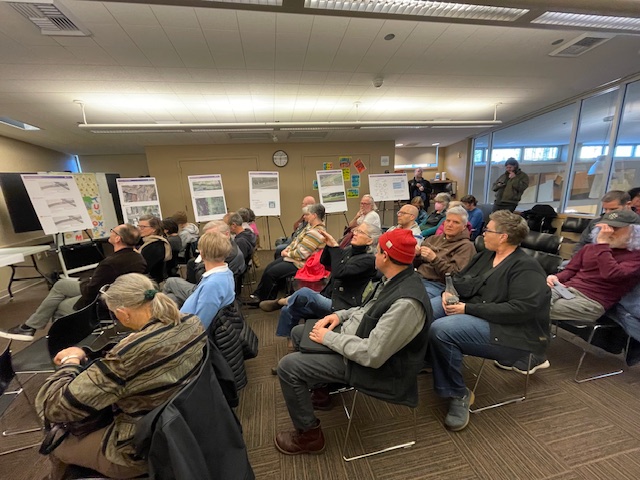
HPAC – the community coalition for Highland Park, Riverview, and South Delridge – has long been asking SDOT for an in-person meeting to answer questions about the lane-conversion project, which is fiercely opposed by drivers who say removing a driving lane will lead to traffic jams on one of the few ways out of West Seattle. Last night, they got that meeting. Judging by various bursts of applause and jeering – which HPAC co-chairs Kay Kirkpatrick and Barb Biondo tried to discourage – that viewpoint dominated among the 50+ people who filled the Southwest Library meeting room, but at least a few supporters were present too.
SDOT has remained resolute that driving-lane removal is not up for debate, but other aspects of the project are. Earlier this week, they unveiled another option for configuring the bottom of the hill, where Highland Park Way meets West Marginal Way. Before that, they announced they would separate the converted lane from the vehicle lane via jersey barriers that could be removed in case of catastrophe like another West Seattle Bridge long-term closure requiring restoration of the second downhill lane. But that didn’t seem to placate those whose memories of the 2020-2022 bridge closure remain fresh. Two people even brought signs, one reading “Fix Existing Problems Before Creating New Ones.”
Last night’s meeting was held in three parts – first, SDOT reps recapped where things stood, then everyone was invited to engage them in conversation around the room, and finally a reconvening of the full room for questions/comments. We recorded the first and third parts on video. Here’s part one:
SDOT reps who spoke were project manager Tony Roberts, project engineer Luke Larson, and project communicator Dan Anderson. They opened by trying to clarify a statement made at the online meeting earlier this month, in which this was described as a “safety project” rather than a “bicycle project.” Yes, but, they said, the money – $4 million – comes from Bicycle Master Plan funding and Vision Zero. In addition, the bicycle lane is intended to address a gap in how riders can get from West Seattle to the Duwamish River Trail. Regarding the newly unveiled Option 2B for handling traffic at the bottom of the hill, SDOT feels that its configuration means two lanes aren’t needed to feed into it any more. Larson said they’d done “modeling” to verify this. They also intend to use plastic center-line posts (like Sylvan Way and Alki/Harbor Avenues) and a high-friction surface treatment – all that will be part of a separate project but concurrent with construction on the lane-conversion. They reiterated that putting jersey barriers on the center line is not an option because they need two feet of width.
When the time came to circulate, about half the attendees did, while the other half stayed in their seats until the full-group session – here’s our video of that:
One of the first to comment declared, “You need to give precedence to the cars over the bikes, I’m sorry.” Anderson acknowledged “this is where we get into disagreement … there’s a lot of expertise … we feel with this it will still work OK.”
In the face of repeated contentions that “this will make it worse,” he insisted, “We don’t believe it will.”
The “what if the West Seattle Bridge goes out?” question also repeatedly arose. Larson said the jersey barriers could be removed to reopen a car lane “within a couple of days.” Anderson also tried to use this to reinforce that SDOT had listened to feedback on some points, saying that SDOT did not expect feedback to include “what if the West Seattle Bridge goes out?”
Another attendee declared, “You’re not solving the crashes – you need to separate the downhill and uphill. Put in some trees like you did on Delridge.”
Then, the question, why not improve the existing sidewalk on the downhill side?
“There’s not room,” said Larson, saying it’s six to eight feet now but they need 10 to 12 feet, adding that the steep dropoff from the existing sidewalk would require “tens of millions of dollars (to be spent) on retention walls.”
A man who spoke in favor of the lane conversion said he’s biked up Highland Park Way “100 times, and downhill maybe once” because of the bumpy path. When this is built, he said, he can put his kids on a bike and ride to South Park. “I will not be driving that street in the future if I can ride the street safely” – one less car, he noted.
A number of concerns were raised by people who live on Othello, a southward turn off the hill. Anderson said SDOT would come out to talk with those residents before long. He also acknowledged that the concept of adding a traffic signal there was mentioned at the meeting, though it hadn’t come up previously.
The SDOT replies to concerns didn’t win over the doubters. One concern about “so much road rage” on the hill was met with a reply that it would be less prevalent with one lane of traffic, if you’re only looking at a car directly in front of yours. That drew derisive hoots.
If the goal is to slow drivers down, why not speed bumps? someone asked. Larson said they’re generally not installed on slopes steeper than eight percent – HP Way is 11 percent.
What about a speed camera? someone else asked. Short answer: That would have to be enabled by state law (which currently limits speed cameras to school zones; the HP Way hill is not part of one).
What about widening the path on the uphill side? Kirkpatrick reminded everyone that the uphill side has had slides, and trees fall fairly frequently.
The SDOT team kept trying to reassure the room that they had “looked at a lot of concept.” Larson mentioned Alki and Green Lake. Those are flat, someone countered. Yet another attendee who described himself as “the most seasoned cyclist in Highland Park”
“By reducing the number of lanes, you’re reducing our quality of lives!” someone said. Another: “This plan is pitting drivers against bikes, but we should be working together.” Another: “This is planning for the future.”
Meantime, alternatives were suggested. Rumble strips? Turtles?
One person also noted that Highland Park has been saddled with a lot over the years, dating back to the municipal-jail proposal that HPAC fought tooth and nail more than a decade and a half ago, and multiple encampments, both RVs and tents, not to ention the future Glassyard Commons tiny-homes-and-RV-lot site close a short distance east of the Highland Park Way hill.
Another tried a final line of questioning: “Is there a date by which you have to spend the funding for this?”
SDOT didn’t really answer that, but Roberts noted that construction is currently set for next year.