
By Tracy Record
West Seattle Blog editor
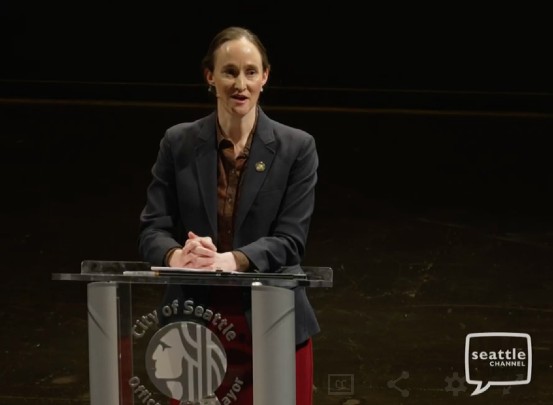
Seattle Mayor Katie Wilson gave her first State of the City speech at the Langston Hughes Performing Arts Institute in the Central Area this past hour.
Here’s our summary and toplines, including two brief West Seattle mentions toward the end.
“You ready for this?” she began, warning it might be her longest speech ever.
Her trademark phrase “This is YOUR city” was heard shortly thereafter.
She said it’s an important time to look at history as we are in troubled times, while also acknowledging the confluence of important occasions – Black History Month, Lunar New Year, Ramadan, and overall “a season of reflections and new beginnings,”
She insisted she is not viewing the city through rose-colored glasses, but with hope. “You have to make the decision every single day to keep moving forward.” She said the double murder of teenagers in Rainier Beach was the most difficult thing that has happened so far in her term, and that the loss needs to lead to change, to protect people. “We have to do better for our kids. … Hopes are not enough …. My job is to take action.” She said an “intensive stabilization plan” for the affected commmunity is in the works, too. “But we can’t just react and stabilize … we have to get to the roots of the problem,” She said, without details, that a new gun-violence action plan will help with that, “tailored to the needs of our neighborhoods and our communities.”
Next, she moved to homelessness. “We simply do not have enough housing, shelter, and services for everyone who is living unhoused.” She said, “We’re doing some things right,” helping thousands each year. But if you look around the city, you will agree, she said, that our approach to homelessness has not been successful. “We cannot keep moving people from place too place and call it successful.” She said encampment removals will continue but she wants to minimize harm to peple in encampments as well as “taking seriously” safety and access to public spaces. She brought up her quest for expanding emergency housing and shelter. “I know we have a big hill to climb,” but she vows to add 1,000 spaces this year “and we are well on our way.” (She did not mention specifics such as the Glassyard Commons RV lot/tiny-house village planned for West Seattle.)
Next topic – ensuring that Seattle is ready “to respond to threats from our federal government.” To be ready for any possible ICE surge here, the Office of Immigrant and Refugee Affairs has been bolstered. And a new webpage is available at seattle.gov/stand-together. She said organizing “the strongeest possible community response” is vital, as observed by a staff member who went to Minneapolis to learn about their response when ICE arrived in force.
Regarding the controversy over city’s plan for more surveillance cameras, she said there are strong arguments on both sides – crime victims’ concerns, privacy advocates’ concerns – fon leaving them up or not. For now, “my team will continue to dig in” to figure out what’s the right thing to do, with no particular deadline.
On to the affordability crisis, “you should not need a six-figure income to live here.” But she said the “economic queeze has been going on so long, it’s hard to believe we can do anything about it.” She talked about past solutions such as the creation of Pike Place Market. “Affordability is not just a poor person’s issue, young person’s issue,” it reaches “high up the scale.”” She announced an Affordability Agenda with four key emphasis areas:
-affordable housing
-affordable child care
-affordable food
-affordable city to build a small business
She said more than 6,000 peple already have answered her Renters’ Survey. “We have heard about people forced to move every year because the rent keeps going up, and more. She reminded that it’s open through Friday, and then she will work with the City Council. She said she’s hearing from property owners and managers too.
And builders – she says more housing must be built and she looks forward to work with many groups “to move forward bolder policy … we need to build a ton of housing” but added that she’s aware this won’t necessarily make housing more affordable “any time soon” so she is working on other ways to help with that.
On to social housing, which is advancing because of a City Council vote last week that will move $115 million into the Social Housing Developer’s operations. Social housing will “give us a new toool to expand our non-market housing,” as approved by voters.
Regarding child care, she acknowledged the much-publicized parental help she’s received, but “right now there are so many gaps for so many children, and our whole society pays the price.”” She said Seattle is seen as a national leader but “that’s a little unnerving as any parent will tell you there’s still so much to be done.” She talked about making it easier to build child-care facilities and building more family-size housing. Preschool and child care should be “treated as public goods, accessible to all” like K-12 education, she declared.
On to food, she talked about grocery-store closures though these stores “are essential community assets.” Programs like Fresh Bucks – which 17,000 participants use – help boost access to food. She said her administration is still exploring the idea of a “public grocery store” but has no specifics yet.
As for small budinesses, she said she recently lunched with a group in the ID and heard a horror story about a two-year permit process. “I know some businesses never open” because of permit waits, not to mention high rents and other factors, She said taxes and minimum wage aren’t what she hears businesses complain the most about, but rather red tape as well as issues like public safety and homelessness. She wants small businesses to apply for currently available programs.
Directly addressing business leaders. bigger ones – she said “affordability is not government’s responsibility alone.” Her message to “Seattle’s employer community” was “we want you at the table” to discuss solutions, “Seattle has always been a city of builders,” building innovation and solutions and more. She wants their help in building “a world-class city that we can all be proud of.”
Mayor Wilson said she didn’t list potential price tags for what she mentioned because first, it’s time to reach consensus and “set the stage to achieve even more …. so let’s start from a place where we agree.”
She listed upcoming events and plans that she said would be steps toward becoming that world-class city that she is certain everyone wants this to be. This is where the West Seattle mentions came in. Reopening Hiawatha Community Center this Saturday (she’ll be there) is one step toward the city she wants to build – she’ll be there on Saturday – and she also mentionbed the upcoming reopening of South Park Community Center., “Community centers are such an important part of” the city. She also name-checked Sound Transit’s Crosslake Connection, opening in March, and then briefly mentioned light rail extending to West Seattle and Ballard. Other transit, she said, must be restored to pre-pandemic levels. She also mentioned the World Cup games this summer, the newly opened waterfront park, an upcoming new exhibit at Woodland Park Zoo, a new Rainier Beach skatepark, the Garfield Superblock,
“I’m not naive …. I know there will be outrages of the week on social media … but I’ve never been more hopeful or excited about what we can accomplish.” She sees the hope around the city, “yes, we can do big things.” And she sees hope in “all the people who make city government run.”
Summarizing, she said, “everything we build” helps build hope, too. She wants her term to be judged on whether people “are excited to live here,” whether this is “a welcoming city” – and to get there, she wants to see people open up to recognize that “another world is possible.” In a year, dhe says, she hopes people will believe “this city is the best city in the world.”
Here’s the full text of the mayor’s speech.