
By Jason Grotelueschen
Reporting for West Seattle Blog
The Alki Community Council meeting on Thursday night at Alki UCC featured a robust candidate forum with six hopefuls for public office, as well as a tsunami-focused emergency-preparedness briefing, and a heartfelt farewell to the council’s leader.
Thursday night was the last official meeting for ACC president Charlotte Starck, who was gifted with flowers and treats from fellow board members to mark the occasion; she said she’ll continue to support and advise the council as needed.
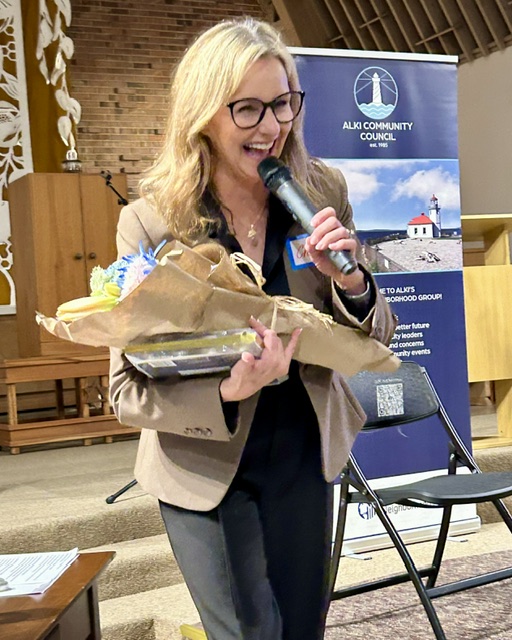
Starck thanked her fellow board members and past and current volunteers, and touted the organization’s accomplishments and its strength going forward.
TSUNAMI AND EARTHQUAKE PREPAREDNESS: Hollie Stark from the Seattle Office of Emergency Management gave a presentation (one of several complementary events in the area recently and coming up soon) about preparedness for earthquakes and tsunamis, and talked about the new tsunami signage being installed at Alki:
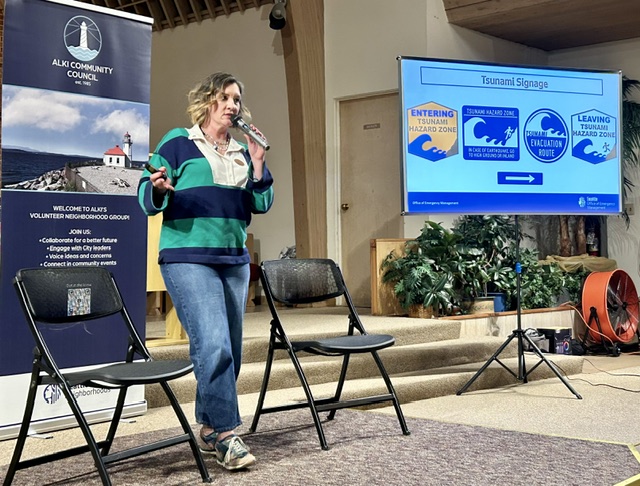
Stark said earthquakes remain the city’s top hazard and tsunamis rank seventh, and the state of Washington has the nation’s second-highest earthquake risk, with the entire state’s shoreline exposed to potential tsunami risk. A Cascadia Subduction Zone event could produce shaking for three to six minutes, while a shallow Seattle Fault earthquake could cause intense local damage and send tsunami waves to Seattle shores within minutes. Deep earthquakes such as the 2001 Nisqually quake remain a onboing threat, particularly to unreinforced masonry.
During shaking, Stark said, residents should “Drop, Cover and Hold On.” After strong or prolonged shaking, which can lead to tsunamis, people near the water should immediately walk inland or to high ground (don’t drive, if you can help it — keep the roads clear for emergency vehicles) and remain there until officials give the all-clear. Tsunamis that are generated from a considerable distance away would likely be announced in advance through wireless alerts, television, radio or NOAA Weather Radio. The risk of multiple waves and very dangerous currents can persist for up to 48 hours. Stark also talked about the new evacuation signs for Alki, and said that her office is available to provide community training and preparedness materials.
CANDIDATE FORUM: General-election ballots started arriving in Seattle mailboxes this week, so it’s time to vote! Thursday’s ACC meeting featured a candidate forum with six candidates who are vying for three positions this fall:
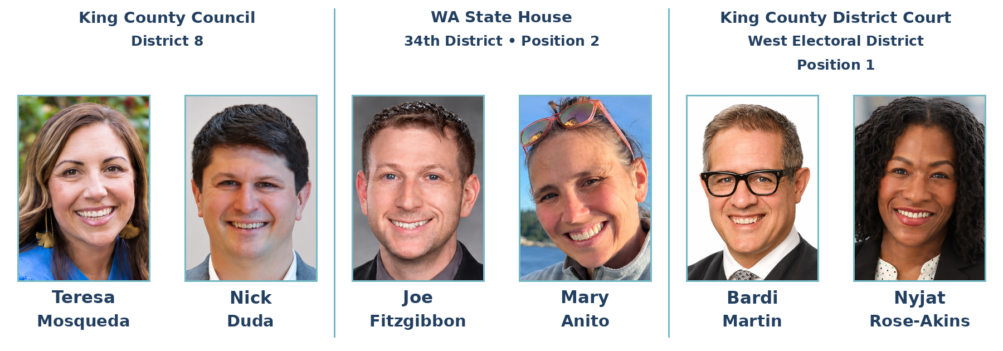
King County Council, District 8: Public safety, homelessness, transit, and county spending.
Washington State Legislature, 34th District: State laws and funding for public safety, education, housing, and transportation.
King County District Court Judge: Misdemeanor crimes, bail, sentencing, and accountability.
The council collected questions from neighbors in advance, and on Thursday night invited each pair of candidates to give opening statements (4 minutes), provide answers (90 seconds each) to three questions, and then closing statements (1 minute). The forum was facilitated by Starck along with ACC vice president Zak Nyberg.
First up were the candidates for 34th District State Rep, challenger Mary Anito and incumbent Joe Fitzgibbon:
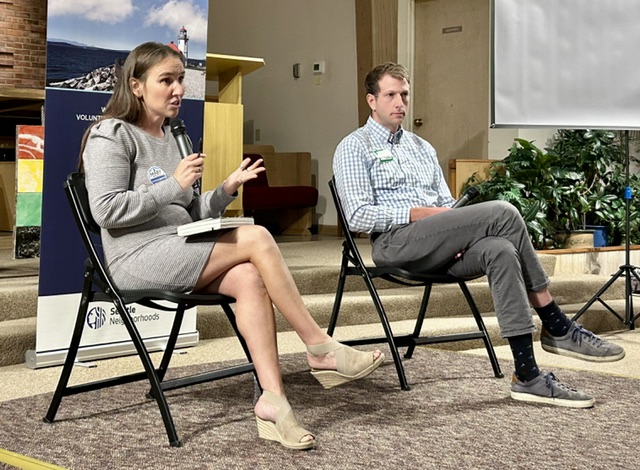
Opening statements:
Fitzgibbon: Talked about House leadership and role as former Environment & Energy chair, and highlighted passage of major climate laws and sales tax exemptions for essentials (like diapers), increasing the Working Families Tax Credit, support for universal school meals, small business tax relief on initial income, and strengthened gun safety (assault weapon and high-capacity magazine bans, and permit/training before purchase). He flagged the upcoming budget challenges until new “millionaire’s tax” revenue arrives in 2029.
Anito: Described her background as an engineer, business owner, and West Seattle public school parent. Said her top priorities are education, housing, healthcare and public safety. Called for reforming the school funding model (weighted enrollment) and addressing understaffing and lack of dedicated resources (like school nurses and social workers, and music programs), expanding affordable housing (including backyard cottages/ADUs) to build wealth, and moving toward universal health care with equitable access.
Question #1: How to reduce the tax burden while still maintaining important services?
Fitzgibbon: Continue removing sales tax from essential goods, sustain/expand senior property tax exemptions, maintain small-business tax relief, explore additional essential goods for exemption (noted community interest in pet-related necessities, for example).
Anito: Said she’s supportive of a millionaire’s tax in principle but criticized the lack of linkage to education funding. Emphasized transparency, results-focused budgeting, and addressing rising property taxes and cost of living.
Question #2: How to stabilize funding for Seattle Public Schools?
Anito: Said she supports a weighted enrollment model, wants to act on OSPI recommendations, require annual school-level reports comparing prototypical funding to actual costs, address large class sizes and missing support systems, and seek education committee assignment to advance reforms.
Fitzgibbon: Noted that he had worked to increase K–12 funding annually, including $1.4 billion more for special education last year. Explained the 2017 shift from local to state funding, and identified a problematic cap on salary funding/revenue and said it should be lifted.
Question #3: How to address public safety concerns in Alki (gun violence, juveniles/repeat offenders, noise enforcement and cameras still pending):
Fitzgibbon: Need to ensure local governments have sufficient revenue to meet core responsibilities (including law enforcement), pursue stronger safe-storage laws to reduce theft/diversion of firearms used in crimes.
Anito: Emphasized enforcement of existing laws, and cited community reports of limited enforceability. Prioritized mental health access and universal healthcare as upstream safety measures, and acknowledged the community’s unease after recent area shootings.
Closing statements: Anito pledged to closely engage with constituents and to have a daily focus on top issues, and emphasized representation and responsiveness. Fitzgibbon asked for voters’ support for him to continue working on sustainable budgets, investments in education/healthcare/childcare/public safety, and prioritizing affordability across areas of energy, housing, healthcare, communications and childcare.
Up next were the two candidates for King County Council District 8, challenger Nick Duda and incumbent Teresa Mosqueda:
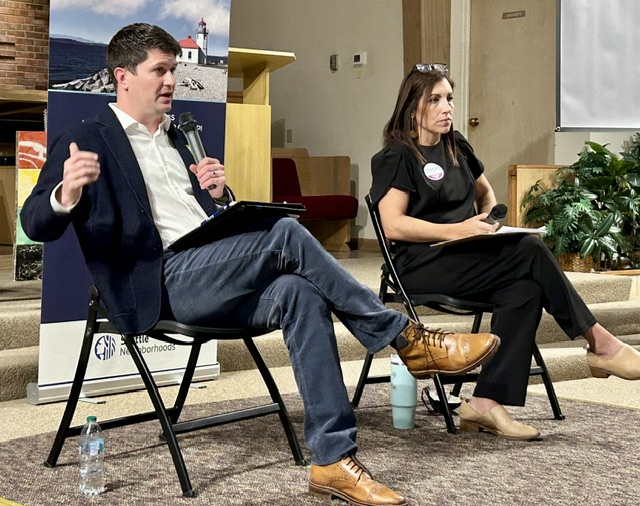
Opening statements:
Mosqueda: Described herself as a frequent Alki visitor with close ties to the area. Stressed local government’s role amid national polarization. Her priorities as Board of Health Chair include public health (clinics, community health centers, Harborview), housing stability/affordability (the Comprehensive Plan), and economic stability for small businesses and workers.
Duda: West Seattle and local resident with a private-sector and public-policy background (background in data analytics). Identified three defining issues—public safety, addiction-driven homelessness response, and fiscal accountability/affordability. Stressed that current approaches are ineffective and unsustainable.
Question #1: How to ensure accountability for publicly funded organizations (through audits and oversight)?
Mosqueda: For the Regional Homelessness Authority (RHA), county contracts are being pulled back to King County departments, an independent financial monitor was hired and changes to governance were proposed. Regarding a DCHS pilot, while the unaccounted amount was revised down to $10,500, any loss is unacceptable. Supported oversight by the Inspector General and offered three amendments to strengthen training, continuous investigations, and accountability.
Duda: Critiqued longstanding control gaps and pledged to rebid 100% of RHA contracts with clear performance metrics and accountability for results. Said that he opposed taxes without specific spending plans and measurable outcomes.
Question #2: How to prioritize and achieve public safety (dealing with gun violence, repeat offenders, jail booking constraints)?
Duda: Proposed a backstop on diversion (such as, limit repeated diversion after multiple offenses) and highlighted current jail intake practice (such as mandatory hospital monitoring if the person says they’ve ingested a substance), removing officers from patrol or prompting releases. Called for fixing the intake process to balance safety and care.
Mosqueda: Noted her direct family experience with the Whale Tail Park shooting, and said she worked to fund gun violence reduction at city and county levels and strengthened regional coordination beyond strict geography. She also highlighted upstream investments (such as outreach/mobile response) to prevent violence.
Question #3: How to better address the issue of homelessness and the RHA path forward?
Mosqueda: Support a smooth transition of county-owned contracts back to DCHS with sufficient staff for oversight, and maintain provider continuity. Expand emergency shelter and permanent supportive housing, and implement the Crisis Care Centers levy (allow ride-ins by first responders/families/self) to improve behavioral health access.
Duda: We need to lead with treatment as the primary intervention, and expand sober recovery shelter options (cited San Francisco’s high demand when those options were launched). Shift funding emphasis toward treatment and redefine success beyond housing placement to independence via workforce training. Flagged the concerning overdose rates in some permanent supportive housing settings.
Closing statements: Duda noted that he and Mosqueda have many shared values but also clear differences, and he seeks effective delivery through data-driven governance and operational execution, and urged his supporters to spread the word. Mosqueda emphasized active problem-solving over finger-pointing, cited actions including prohibiting ICE staging on county property, contracting reforms to support minority-owned businesses, and eliminating AI-driven practices that escalated rental costs.
The final candidates of the evening were the judicial candidates for King County District Court, Position 1: Incumbent Judge Bardi Martin and challenger Nyjat Rose-Akins.
Opening statements:
Martin: West Division District Court judge, serves on the court’s security committee, presides over Community Court connecting people charged with low-level crimes to services. Worked ~1,000 hours as a pro tem judge prior to appointment, was a former public defender, criminal defense, and civil litigator.
Rose-Akins: 16 years with City of Seattle, as a prosecutor (domestic violence, DUIs), specialty courts (Community Court, Mental Health Court), and assistant city attorney (community-facing civil work). Full-time pro tem judge the past three years, serving in nearly all of the district courthouses. Described herself as a U.S. citizen naturalized in King County, originally from Kingston, Jamaica.
Question #1: How to balance public safety and defendants’ rights for repeat offenders?
Martin: Said that he applies Court Rule 3.2 (presumption of release) and weighs factors such as failure-to-appear risk, community safety, compliance history, criminal history, and community ties before imposing bail.
Rose-Akins: Said that she reviews the person’s performance in other pending/prior cases (appearances and compliance with conditions) to assess risk and set appropriate conditions.
Question #2: How do we break the cycle or homelessness, addiction and repeat offenses?
Rose-Akins: Combine accountability with connection to treatment/resources, and set and monitor treatment requirements. Acknowledged the challenges but also cited successes that she has seen in court, such as moves toward sobriety, jobs and housing.
Martin: Uses Community Court for linking people to essential services; can order treatment through sentencing. He noted the court’s limited authority to compel housing solutions; may impose stricter sentences for repeat violations.
Question #3: If you had a “magic wand,” what is a change to the law that you’d like to see to better protect the public?
Martin: Mentioned the example of impound hearings, saying the law tightly restricts judicial discretion in this area. Cars are sometimes also where people are living. He would like legislative changes to allow more equitable outcomes (while noting judges do not write laws).
Rose-Akins: Reiterated that the judicial role is to apply existing law, ensure fairness, and avoid legislating from the bench.
noted that he is supported by West Division colleagues. Emphasized the importance of listening and fairness.
Said she’s rated “exceptionally well qualified” by six bar associations. Focuses on plain-language proceedings with a motto of “accountability with compassion.”
NOTE: If you missed our previous WSB candidate coverage, last week’s West Seattle Chamber of Commerce forum at Youngstown also included the candidates for County Council and Legislature.
EVENTS AND ACTIVITIES
Cindi Barker from Seattle Emergency Communication Hubs gave a quick plug for the upcoming Alki Emergency Hub Intro Meeting on Tuesday, Oct. 20 from 7-8:30 pm, also happening at Alki UCC and featuring hands-on demonstrations and education.
Other upcoming events sponsored by ACC include two holiday happenings at Alki Beach Park: First up is Alki Trick or Treat noon-2 pm October 24, followed by Alki Holiday Lights (coinciding with the beloved Argosy Christmas Ships) on November 27 (volunteers needed!)
Board members also encouraged people to check out the Log House Museum’s Beyond Alki exhibit (open Thursday-Saturday), which opened in recent months.