
By Macey Wurm
Reporting for West Seattle Blog
After eight weeks of planning and construction, 9th graders from Maritime High School are bringing their floating-wetlands pilot project to a close in West Seattle waters, another step toward saving salon.
The school’s entire freshman class – 23 students – worked together learning how to use hand tools, power drills, and a newfound understanding of a human-made floating wetland’s restorative role in the Duwamish River’s ecosystem.
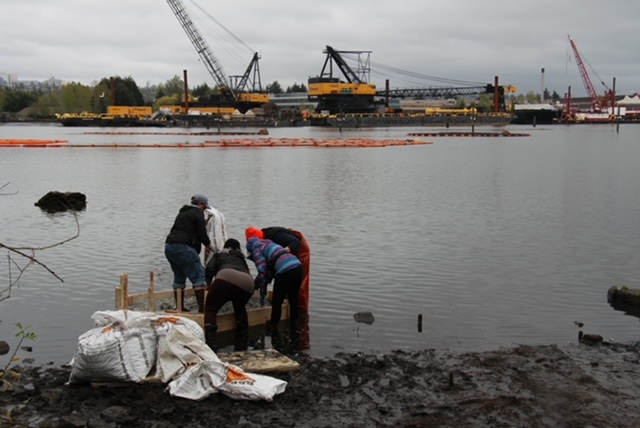
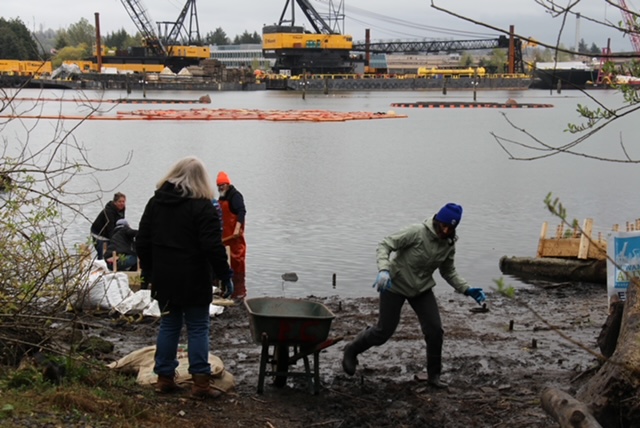
The project was a partnership with the River Access Paddle Program and the Port of Seattle, funded by the Rose Foundation. Saturday morning at Herrings House Park on the river, community members were invited to be involved with the construction of the last two floating wetlands, with the first two entirely built and planted by the students two weeks ago.
Floating wetlands are being used to provide habitat for juvenile salmon. The lower part of the Duwamish River is highly industrialized and the banks are mostly “armored,” which means rock without a place for juvenile salmon to feed, as explained by Sharon Leishman of the Duwamish Alive Coalition. These juveniles need their bodies to adapt to go from freshwater to saltwater, and the wetlands help create a space for these necessary changes.
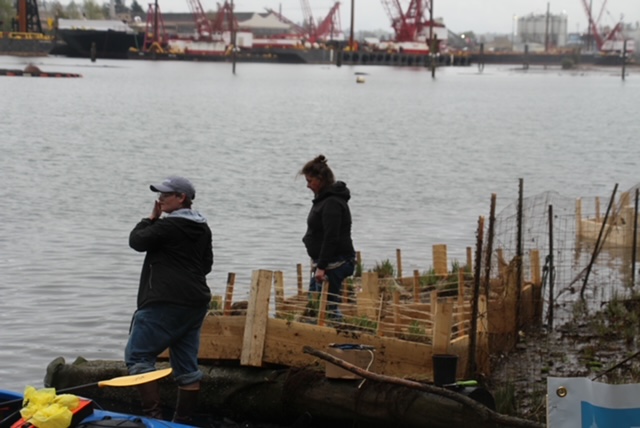
Leishman was also involved in a floating-wetlands project with the University of Washington in 2019 in Lake Union. This project differs in that these use air-infused recycled glass instead of plastic for buoyancy. This change was made in an effort to eliminate the harms of microplastics.
This was the first floating wetlands project taken on by Maritime High School, and its continuance in the future will depend on whether or not the program can secure a location for more wetlands to go. In this case, George Blumberg with the port helped the school to find the location – a dock space on Harbor Island that the port can’t rent out by the port because it’s too small for boats.
Regardless, the school will continue with projects that incorporate similar learning outcomes. “The thing that really works for us and that we want to replicate is: How do we combine some of that construction skills training that we want to do with restoration?” mused Tyson Trudel, who works at Northwest Maritime, which brings the “intensely maritime parts” of the curriculum to the school.
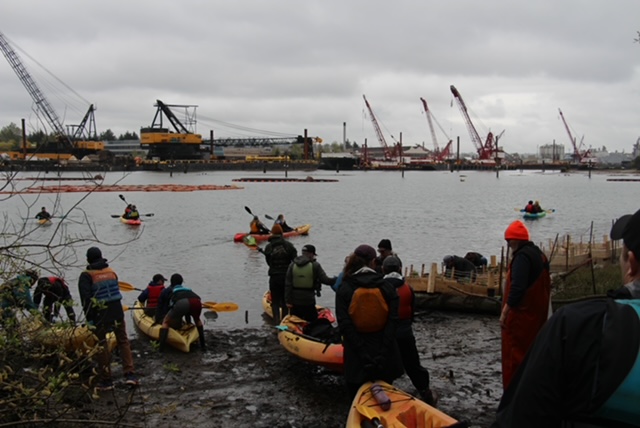
Coinciding with the community assistance in building the second two floating wetlands was the semiannual kayak cleanup organized by the Duwamish Alive Coalition. In the spring, this garbage cleanup project is hosted with salmon retention in mind. The first group of kayakers went out at 10:30 Saturday morning, with the second deploying around 12:30.
Both projects are centered around taking care of the Duwamish River and its surrounding land. “This area right here has such huge environmental, social, and historical significance because Seattle would not be the place it is today without the industry that started in this valley,” Leishman said.
You have a chance to help next Saturday in the spring edition of the mega-work party Duwamish Alive! Partner organizations include Dirt Corps and the Green Seattle Partnership. Dirt Corps, an organization specializing in developing skills for green jobs, will be at həʔapus park, and Green Seattle will be at Herring’s House. The Duwamish Alive Coalition also plans to present awards to four dedicated volunteers in the opening event at Herring’s House park. To volunteer Saturday at a Duwamish Alive! site, go here.