
By Tracy Record
West Seattle Blog editor
 Two pending projects were in the spotlight during last night’s monthly meeting of HPAC, the community coalition for Highland Park, South Delridge, and Riverview, facilitated by co-chair Kay Kirkpatrick. Her’s how it went:
CRIME TRENDS: The meeting opened with SPD Officer German Barreto saying that most Highland Park crime categories are down, year to date. One exception: Burglaries, some of which involve vacant homes. Another: Confirmed gunfire. As he noted, shell casings that are collected go into a database and investigators can see if they match other incident. No word of any revelations from that process so far this year; Officer Barreto said the area has seen eight incidents so far in 2026, compared to six by this time last year: “Not really good.” The officer also mentioned walking through some encampment areas like one off SW Detroit, and he said he’s been notifying the Unified Care Team about what he finds. He said he’s hopeful the UCT will get to that area, but doesn’t know when. That led to several attendees voicing encampment-related concerns; one asked about 24th/Barton/Henderson, and Officer Bareto said he’s aware of that because that area is reoccupied repeatedly. Kirkpatrick said they’re in contact with City Councilmember Rob Saka‘s office on that too. Another attendee said fires are a concern with the encampments in greenbelts. Officer Barreto suggested people keep reporting via Find It Fix It, and include photos, albeit ones taken from a safe distance. One person with property in south Highland Park mentioned a problem one of her tenants had had – but the tenant hadn’t reported it to police. “Please report it, we’re data-driven,” said Barreto. He also mentioned the option to report online, provided the crime in question isn’t something that’s happening right now (if it is, call or text 911).
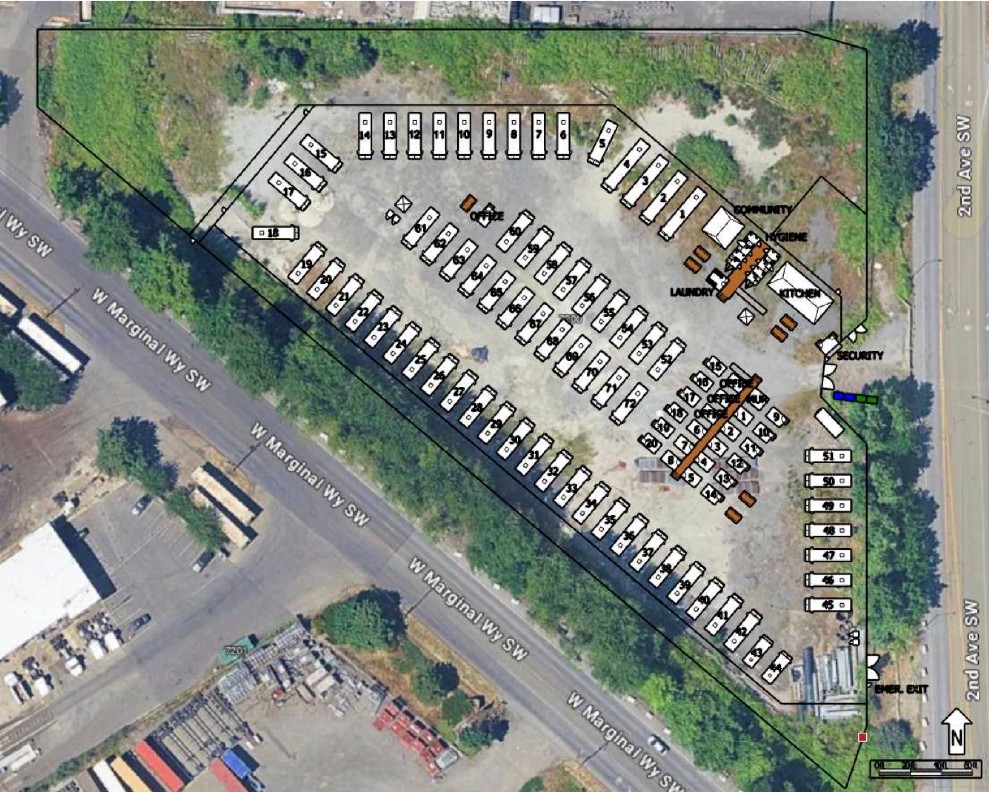 (‘Site plan’ from city permit filings for Glassyard Commons, with 72 RV spaces and 20 tiny houses)
GLASSYARD COMMONS: Marta Kidane from the Low-Income Housing Institute, which will operate the tiny-home/RV-lot site Glassyard Commons at 7201 2nd SW, was the next guest. (We’ve been reporting on the plan since breaking the story about it in January.) She first explained the concept of tiny homes – 8 x 12, “the dignity and privacy of having a closed door, heat (and A/C in the newer ones),” in villages, with shared spaces where people can cook and eat, plus hygiene trailers with showers, sinks, toilets, etc. And they have 24/7 staffing, with sign-in sheets, case managers there during weekday business hours, to help people negotiate the system. They also have behavioral-health providers at many sites.
Glassyard Commons would be LIHI’s second RV lot, twice as big as the now-dismantled first one, which Kidane said led to the demolition/removal of 67 RVs (entering a lot like this means you agree to eventually give up your RV). People are in their programs for an average of six months before moving on to housing.
One attendee wondered if the Glassyard Commons plan – on state-owned land – is a done deal. The answer was, pretty much yes. Another attendee who said they still had questions lingering from LIHI’s public meeting in Georgetown (WSB coverage here) such as, what’s the definition of “surrounding area” and what will be done about people already camping in the nearby greenbelt? She didn’t have information on that, but, “I think it’s all about developing relationships” which the UHeights Vehicle Outreach Team working with them will be trying to do.
One attendee mentioned someone often seen at Highland Park Way/Holden seemed like a perfect candidate for a tiny home. Could she refer him to LIHI’s partners? Kidane asked for information.
Kirkpatrick brought up the letter that HPAC had sent to the city and said one unaddressed point was the request for proactive cleanup for a mile each way from the facility. “They’ve only adopted 500 feet, which is only going to take us to the edge of the block,” she said. Kidane contended that “tiny house villages often make the area around them safer … there’s a level of activation” resulting from their presence. She offered to take people on a tour of a current tiny-house village. “I think when you see it you really get an idea” of how it works. (West Seattle already has one, Camp Second Chance on Myers Way. Expanding it remains a possibility, Kidane said in response to a later question.)
One attendee asked for more details on what happens to the RVs that are turned over when their owners get housing. Are they resold? No, they’re scrapped, Kidane said. (Before the RVs are brought on site, they’re decommissioned, including rendering their bathrooms unusable, meaning the RV residents have to use the hygiene trailers too.)
She mentioned an outreach team working in the area, so that led to questions such as, what happens to people who decline shelter/services? That’s more a question for the outreach team, Kidane said. But for RV dwellers, they appreciate having some control of their own space. Is the outreach for Glassyard Commons going to start in Highland Park? Yes, reiterated Kidane. But it won’t be limited to people found in West Seattle.
Can people smoke and drink in their tiny houses? Smoking is prohibited, and they have smoke detectors, but otherwise, there aren’t prohibitions about what they can do behind closed doors, though, she noted, they are made aware that recovery services are available. (Weapons and even guests from outside the site are prohibited too.)”
Kirkpatrick noted that HPAC has signed up to participate in the Community Advisory Council for Glassyard Commons, once it’s launched. Meantime, we asked Kidane after her appearance if there was any update on a timeline for costruction, as it had been said repeatedly that this site was on a fast track. Short answer, no,
SDOT’S HIGHLAND PARK WAY HILL PROJECT: Kirkpatrick said HPAC’s been talking to Councilmember Rob Saka‘s office about longrunning concerns regarding the lane-conversion plan, but it appears his office won’t be “intervening,” so feedback should be shared at the “agency” (SDOT) level. She asked attendees to list their concerns/observations about the project (and also invited supporters to speak up). Several concerns were voiced, including:
-A SW Othello resident said city reps have not yet made good on their promise of a walk-through with neighbors
-There are options not being addressed and a conversation needs to be had with engineers
-Restricting downhill to one lane means there’d be no way to get out of the path of a dangerous oncoming driver. “They need to re-engineer the whole road,” suggested an attendee. (Kirkpatrick noted that Saka had called for a Vision Zero audit, as we previously reported)
-Enforcement could make a big difference. Kirkpatrick said she was just back from a road trip in other West Coast states and they saw lots of it.
-One attendee said they expect there’ll eventually be a two-lane result. The discussion devolved briefly into a cacophony of other suggestions.
HPAC meets fourth Wednesdays most months; watch hpaction.org for updates.