
By Tracy Record
West Seattle Blog editor
“We’re not here to scare you.”
That’s how Tyisha Brown El started the recent tsunami-preparedness presentation the city Office of Emergency Management gave at Delridge Library. With the Great Washington Shakeout drill coming up this Thursday (10:15 am on 10/15), it’s timely that earthquake preparedness was the emcompassing context.
Brown El was there to educate, prepare, and support “community commitment.” She also pointed out this is information that could help you anywhere on the coast.
She asked the attendees – who eventually totaled seven – “what word comes to mind when you hear ‘tsunami’ or ‘earthquake’ preparedness?” One man said: “High ground.” Brown El then revealed that earthquakes are the number one hazard in Seattle.
And those earthquakes aren’t going to be gentle – 3 to 5 minutes of shaking. Subduction-zone quakes – magnitude 9-plus – happen every 200 to 600 years, and the last one was “in that window,” she noted.
The window for the “deep Juan de Fuca plate” type of quake – like Nisqually in 2001 – is every 30 to 50 years, so we’re almost “in that window” too.
And scientists aren’t sure how often the crustal fault type of quake – Seattle Fault, which runs through West Seattle – might recur.
On to tsunamis. She showed an explanatory NOAA-made video that’s among the resources you’ll find here.
Know your route(s) to safety – from work or school(s) as well as from home. Especially the schools!
A “seich” is something to beaware of too – the Duwamish River might be susceptible. So might a hotel rooftop pool!
Knowing the difference between local and distant tsunamis can be the difference between feeling or not feeling the earthquake. Where do you go? Just get out of harm’s way. Even if it’s a distant-tsunami risk, you’ll get an alert. If you’re on the ocean coast, you might have 15 minutes to get somewhere. Don’t get in your car – you’ll get stuck in traffic – so evacuate on foot. Get moving if you feel the quake. (Maps are on the city website.)
What can Seattle expect?
“You will be inconvenienced dramatically,” at the very least. Waterfront impacts, visitors stranded, people stranded outside the city, ferries/cruise ships will be stranded or maybe even damaged; “your home may or may not be standing” afterward.
She showed video from Japan and California in 2011. Risks include strong/unpredictable currents, water-level fluctuations, debris in the water, contaminated water/sediment.
(Some places have no high ground – Westport just broke ground on a tsunami-evacuation tower.)
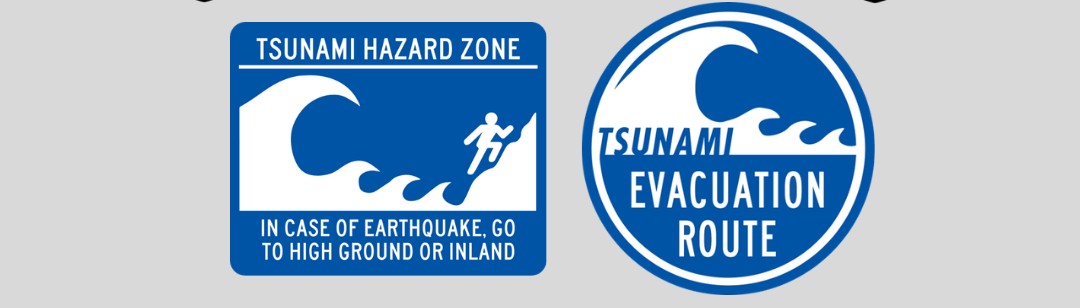
She showed the forthcoming Seattle signs but said the locations and timing haven’t been finalized yet – it’s up to SDOT. They will NOT have sirens, though – those are NOT planned for Seattle. (The ones on the coast will be tested during this Thursday’s drill, so be aware if you have a trip planned!)
Then she spoke about a different kind of sign – the natural signs of tsunamis – ocean water bubbling, sudden rise or fall of the ocean, loud roaring sound from the sea, long/strong ground shaking at the beach. “If you start hearing something abnormal, just act!”
Also, your phone will sound with a tsunami alert, an emergency tone. Levels of alerts: Information Statement, Watch, Advisory, Warning.
She showed drop/cover/hold on info for surviving a quake, wherever you’re at, including whether you’re in bed or in a car. She also showed a video of “what 15 seconds of shaking looks like,” with shelving and a water heater falling over. And she repeated the oft-heard advice about keeping shoes in your bedroom because broken glass is a source of injury.
Once the shaking stops and it’s safe to move, “grab your ‘go bag’ and head inland to high ground.” Then “when you get there, stay there – Tsunami waves might continue for 24 to 48 hours.”
Speaking of that “go bag,” know where you are on your preparedness journey – that’s stuff that’ll cover you for three days (including some cash, extra glasses, your prescription medication. For your home, have two weeks of stuff – subsistence food that doesn’t require cooking, first aid, water, etc. (And remember your pets!)
(More info at disasterreadywashington.com!)
If – when – something happens, it’s too late, so you might as well prepare, she reiterated.
Another thing to think about – reunification. Where will you and your loved ones meet up if you are, or, get separated when disaster strikes? Pick a park, a library, or some “middle ground.”
Keep a written list of important phone numbers with your waterproofed documents, especially someone who lives out of state that might be outside the disaster zone. Connect with your neighbors. (“Isolation doesn’t work,” one attendee observed.) Know where your nearest Emergency Hub is (and as an attendee noted, consider volunteering).
Sign up for alert services like the city’s AlertSeattle.
And familiarize yourself with the infomaps at Seattle Hazard Explorer.
ALSO: This Thursday’s Alki Community Council meeting includes a tsunami-prep briefing – 7 pm at Alki UCC (6115 SW Hinds).
P.S. Would your workplace benefit from a briefing on preparedness? Request one! email oem@seattle.gov