
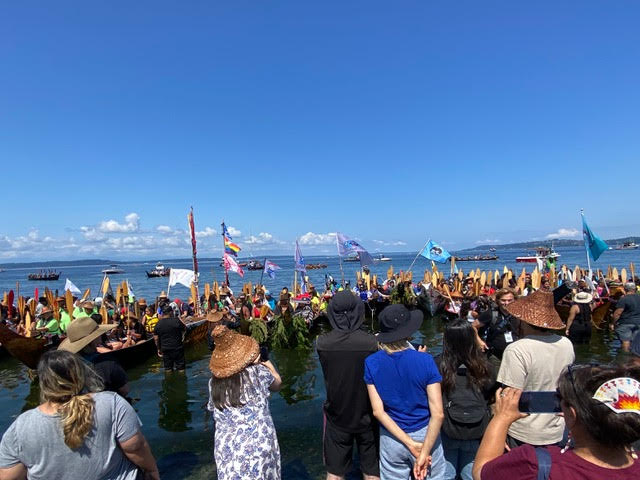
 (Alki Beach Park Paddle to Muckleshoot 2023)
By Anne Higuera
Reporting for West Seattle Blog
A little more than a month from now, on the last Wednesday afternoon in July, tribal canoes will arrive at Alki Beach.
First, one or two, then another handful coming into view on the waters northwest across the sound, until more than 100 canoes are expected to glide to shore to be welcomed by the hosting Muckleshoot Indian Tribe. It’s an event that brings thousands of people to the place where land meets water and the traditions of the past intersect with the present, to witness pullers from dozens of American and Canadian tribes arrive with a goal of, “Healing our waters by honoring our ancestors.”
The Nisqually Tribe is the host for this year’s Tribal Canoe Journey, which is called Paddle to Nisqually Medicine Creek Potlatch. Most stops on the journey are hosted by tribes along the route (see map), and the Alki stop is the second to last one before the final landing in the South Sound.
This year, canoes will start in a variety of places: The Quinault on the Olympic Peninsula will head north to the Strait of Juan de Fuca, joining coastal canoes along the way and eventually meeting up with those from both coasts of Vancouver Island and coastal British Columbia at the Lower Elwha Klallam Tribe, which hosted the journey last year near Port Angeles. From there, they will join up with even more to head south.
Tribal Canoe Journeys started in 1989, with 17 tribes participating in the Paddle to Seattle during Washington’s centennial celebration. It became an annual event starting in 1993, uninterrupted until it was canceled for two years during the pandemic. Hosting tribes take on the cost and organization of an event that accommodates and feeds more than 5,000 people camping for up to a week of Protocol, where each canoe family takes a turn telling stories and sharing their culture and language. There’s a huge Protocol tent, vendors, restrooms, and showers, medics and so many volunteers. It’s a massive undertaking that requires years of planning and a tribe with resources to pull it off.
Along the way to the destination, tribes like the Muckleshoot that are designated overnight stops have to plan to host however many canoes arrive on that day for a night of camping, food and a shortened Protocol. “Nisqually only has 53 canoes registered right now,” says Autumn MaGee, the canoe family manager for Muckleshoot, who says she’s using the last Alki landing in 2023 as a gauge for likely attendance, when there were 126 canoes. “We’re still thinking there will probably be 110-120 because next year’s [Tribal Canoe Journey] hosting is in Alaska and a lot of families won’t be able to travel to that.”
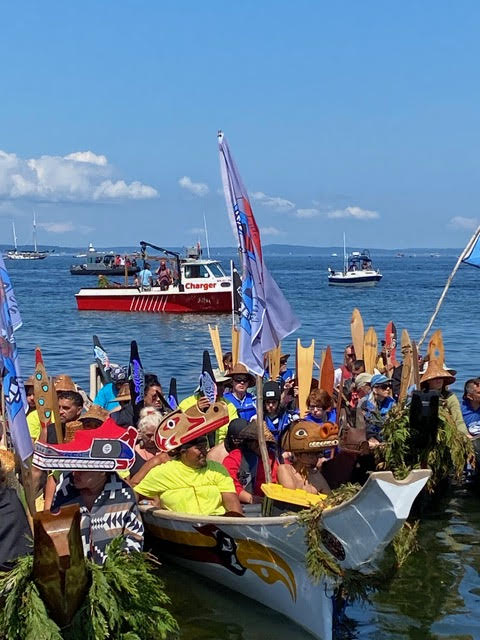 (Canoes waiting to be welcomed ashore at Alki in 2023)
The canoes arriving at Alki will likely be coming from Suquamish, which is hosting for the two prior nights. Leaving around 10 am from Suquamish, MaGee says she expects the canoes will begin to arrive between 1-3 pm, depending on the weather, currents, and the speed of the pullers. “Some are faster, some are slower.” As they arrive, each canoe will be greeted in turn by the Muckleshoot, who will set up tents and seating near the Bathhouse as they did in 2023. A microphone will be passed for pullers to say the name of their canoe and tribal affiliation, talk about the challenge of the day’s paddle and how welcome a rest would be, and then request to come ashore. Once invited to land by the Muckleshoot, the work begins again, paddling to the landing area and carrying the canoe above the tideline on the beach.
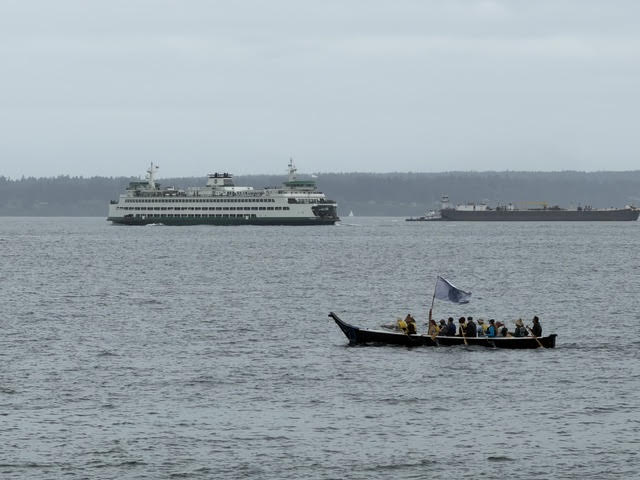 (Blue Heron Canoe off Duwamish Head last Saturday)
“Some wood canoes start at 1,000 pounds,” says Mike Evans, father of the Blue Heron Canoe, which he says has been on every sanctioned canoe journey since 2003. The Blue Heron is a composite canoe, brought to life by Evans and his father using wood, fiberglass and epoxy, and weighing in around 650 pounds. The canoe comfortably carries 12 people, and it can take almost that many to carry it across the beach. Last Saturday, he had the full complement, including his son and 11-year-old granddaughter, launching from Don Armeni Boat Ramp for a practice paddle from there to Blake Island. The water was choppy with wind out of the southwest and it took 2 1/2 hours to get there. The Blue Heron will have practice paddles on weekends around Puget Sound until Canoe Journey starts, and plans to be among the canoes arriving at Alki on July 29th.
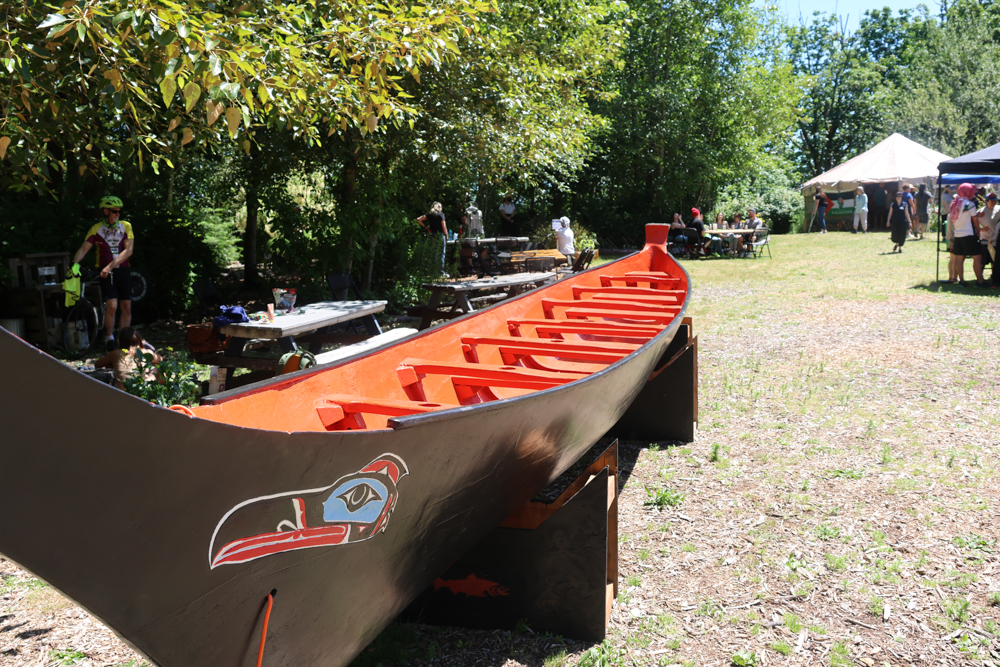 (Canoe at Duwamish/Heron’s Nest event June 13)
The Duwamish canoe Kikisoblu (named after Chief Seattle’s daughter) will take a “less traditional route,” on this year’s journey, says the tribe’s Executive Director Kristina Pearson. She’ll be among the 15 pulling with the Duwamish canoe family as it leaves for Blake Island on the 29th, meeting up with some other canoes, and then joining the larger group further south for the final landings and Protocol. Pearson says their next practice is on the 5th and paddlers this year are mostly women, including their skipper Lee, who guided them to Lower Elwha last year.
While practices are still on the calendar, MaGee with Muckleshoot is actively working on the logistics for the Alki landing, coordinating with private security, King County Sheriffs and Seattle Police for the days of the event and to check on the canoes while they are on the beach overnight. They’ll also provide public parking with a coach bus shuttle from a lot owned by the Port of Seattle on Harbor Ave SW on July 29th to reduce car traffic along Alki Beach.